Although the pace is slowing, apartment rental rates have been growing nationally for eight consecutive years, a new report from RealPage shows. And overall this cycle, which began in 2010, U.S. apartment rates have grown 28.5%.
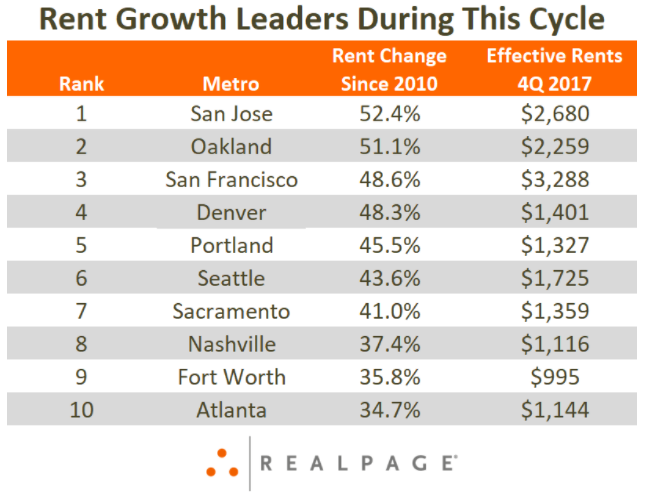
On an individual basis, markets on the West Coast have led the way in terms of rent growth, including six of the top 10 leaders since 2010.
Of the 50 largest U.S. apartment markets, the three Bay Area (California) metros were the national leaders for rent growth during the current cycle, according to RealPage. San Jose led the pack, logging rent growth of 52.4% since 2010. Operators in Oakland pushed rents 51.1%, while San Francisco rents were up 48.6% for the current cycle.
To break down the growth of these three markets, RealPage noted that each experienced peaks at different points in the cycle. In San Jose and San Francisco, rent growth peaked early in 2011 and 2012, while Oakland saw its high-water mark in 2015. Also in San Jose and San Francisco, rent growth early in the cycle was explosive, regularly reaching double digits, the analytics firm says. However, for all three Bay Area metros, growth has dropped off significantly in recent years, registering below 3% in 2017.
The Bay Area also ranked as a national leader for average effective rents at the end of 2017. San Francisco’s average prices were at $3,288, a rate beat only by New York City. San Jose and Oakland weren’t far behind, with effective rents at $2,680 and $2,259, respectively, according to RealPage.
Other Markets of Note
Although Denver has been one of the nation’s 15 most active construction markets this cycle, rents have still risen there 48.3% since 2010. “Model demographics and economic growth were among the reasons this market has done so well in the face of such heavy supply volumes,” RealPage says in its report. “Like the Bay Area, Denver logged strong performances early in the cycle. But annual rent growth actually peaked near 12% in 2015 before coming down in more recent years. Average prices were at $1,401 in Denver at the end of 2017.”
Other West Coast markets that have posted big numbers include Portland, Seattle, and Sacramento. Portland recorded a total increase of 45.5% since 2010, while rents went up 43.6% in Seattle. Portland rent growth peaked near 13% in 2015 but has come down significantly since then.
Seattle has managed to sustain strong rent-growth levels throughout most of the cycle. “That’s remarkable, given a big volume of new apartment additions over the past eight years. However, the market has seen some moderation recently,” the report states. “While still solid, occupancy has come down from its recent peak, and the pace of rent growth is nearing the U.S. norm.”
Sacramento was a late-cycle recovery story, according to RealPage, but rent growth there has been booming lately. Sacramento has ranked among the top five major U.S. metros for annual rent growth in each of the past six quarters, as occupancy remains very tight and construction has remained limited. In total, this metro has registered price increases of 41% since 2010.
Rounding Out the Top 10
Nashville, Tenn.; Fort Worth, Texas; and Atlanta close out the national top 10 list, with each of these markets recording rent hikes between about 35% and 37% during the current cycle. Average rents in Nashville surpassed the $1,000 mark for the first time, in mid-2015, and now sit at $1,116. Only recently has performance moderated in Nashville, as already-elevated apartment completion volumes have climbed into record territory, RealPage says. Last year, Nashville’s inventory grew 7.4%, the highest annual expansion rate among all major markets since 2010.
Fort Worth saw rent growth peak at around 7% in 2015 and 2016 but is now logging price hikes closer to the metro’s historical norm as apartment deliveries have increased, RealPage explains. Atlanta was also a relatively late-cycle achiever, with rent growth peaking in 2014 and 2015 before coming down to a more moderate positioning at 3.3% in 2017.