
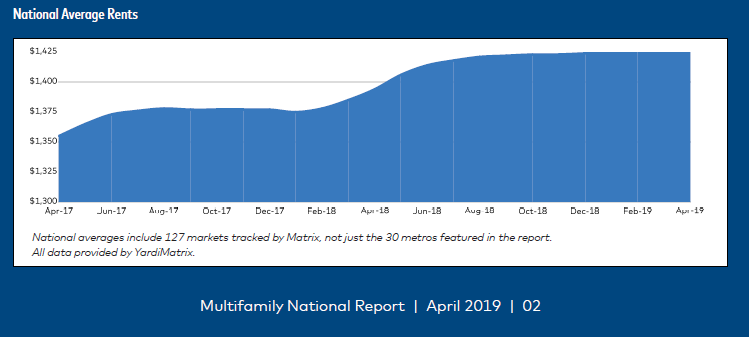
The national average multifamily rent rose by $5 to $1,436 in April 2019, up from $1,431 the previous month, according to the latest Matrix Monthly multifamily report by Yardi Matrix. At the same time, the nation’s rent growth rate fell to 3.0% year over year, down 30 basis points from March. Rents have risen 0.8% this year to date, though this still trails the growth rate of previous years.
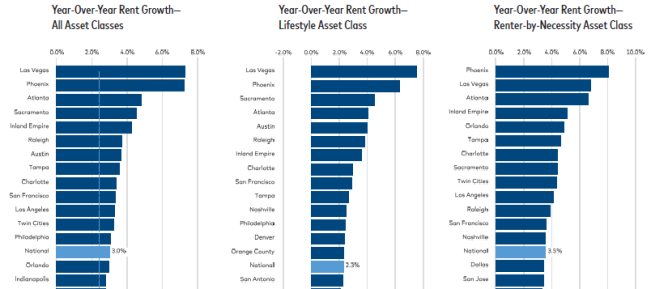
Rents rose in all of the top 30 markets over the past year, led by Las Vegas and Phoenix metros with 7.3% rent growth year over year. Southwest markets take many of the top spots this month; most of the top 30 markets show consistent rent growth between 2% and 4%, landing close to long-term averages. Only Houston, at 0.6%, has rent growth lower than 1.4%.
In Phoenix, market-rate Renter-by-Necessity rents rose by 8.0%, compared to 6.3% growth in luxury Lifestyle rents. In Las Vegas, Lifestyle rent growth outpaced RBN at 7.5% to 6.8% – one of the only markets in the nation where luxury rent growth outpaces workforce rent growth.
On a trailing three-month (T-3) basis, rents rose by 0.3% in April 2019 – an acceleration Yardi considers “typical” for the rental season. Raleigh and Charlotte, N.C. led the nation with 0.5% growth on a T-3 basis, establishing themselves as the fastest growing recent rental markets. Yardi attributes this growth to other metros’ temperate weather and employment opportunities.
Most metros have remained solid by this metric, which compares the last three months to the previous three months. Even gateway markets, which have generally underperformed on a T-3 basis in recent years, have experienced solid rent growth – rents in San Francisco, Washington, D.C., and Boston all rose by 0.3% on a T-3 basis.
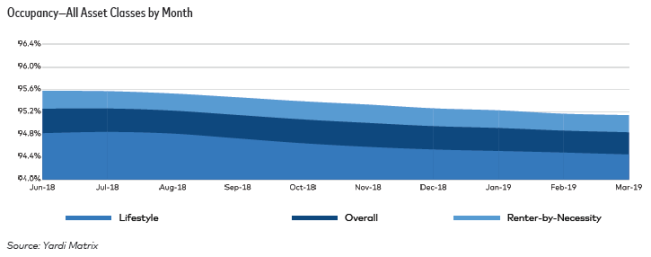
Multifamily absorption remains strong, and the occupancy rate for stable properties has only fallen 10 basis points to 94.8% this year to date, despite ongoing supply growth. The economy continues to create over 200,000 new jobs each month, and the homeownership rate has fallen 60 basis points in the past month, down to 64.2%.
As of Q1 2019, Fannie Mae and Freddie Mac have raised the pricing differential between “capped” loans, or loans with no strings attached, and “uncapped” loans, or loans that require borrowers to meet energy-efficiency requirements or seven low-income tenants. The spread between capped and uncapped loans was 5 to 20 basis points early in the year, and has now grown to 30 to 55 basis points.
Both agencies originated $30.3 billion in loans in the first quarter, up 20% from this time last year. The new price spread is intended to slow down capped loan originations, which are limited to $35 billion each year, and incentivize uncapped programs for borrowers.
Regulations on “green loans” have also been tightened, enforcing stricter energy and water requirements in order to qualify. However, according to Yardi, multifamily borrowers are willing to pay the cost to meet environmentally-friendly construction requirements if it means a lower interest rate on their property loan.