

Wellness and sustainability have become top priorities for today’s renters, reshaping what they expect from multifamily communities. J. Wickham Zimmerman, CEO of Outside the Lines, a design-build specialty company that creates water features, rock work, and themed environments for commercial real estate nationwide, shares how thoughtfully designed amenities—from water features to community gardens—can elevate resident experiences while delivering long-term value for owners and operators.
How does wellness factor into both new and existing multifamily properties now?
While green spaces and wellness amenities have always been desirable, they have now risen to the top of renters’ wish lists. One recent study from JLL found that green spaces rank just under safety and affordability, while another survey from the National Multifamily Housing Council in 2024 found that 74% of renters consider sustainable features to be important.
With wellness and sustainability both at the forefront of renters’ minds, it’s now more important than ever for both new and existing multifamily properties to consider adding or upgrading on-site amenities that are eco-friendly and offer convenience and comfort.
Focusing on wellness amenities that offer a combination of sustainability and technology can be a smart strategy that adds a competitive edge in today’s multifamily market.
What are some of the amenities that residents are demanding, and which provide the most value as we look to the future?
Smart amenities today are all about the resident experience. Beyond fitness centers and clubhouses, we’re increasingly seeing multifamily owners and developers incorporate everything from yoga studios and walking trails to community gardens and cold plunge pools.
The amenities that provide the most value, for renters and for owners, are those that have a direct impact on daily comfort and convenience. At The Sinclair in Dallas, we created a dramatic Zen-inspired water feature at the entrance of the building to set the tone. Residents there can enjoy lush private gardens without leaving their community, as well as a spa-inspired private pool terrace with views and poolside service.
In addition to biophilic design and nature-inspired experiences, systems that help reduce utility bills are also valuable amenities. Streamlined recycling and composting, as well as energy-efficient appliances, are becoming the norm.
Speaking of design, community-centric designs that foster social connections among residents are also growing more common. In today’s digital culture, community spaces where residents can connect with their neighbors are a valuable amenity, as are the programs offered in those spaces, such as workshops on sustainability, gardening that take place in a rooftop garden, or a community greenbelt.
How is new technology, such as artificial intelligence (AI), affecting the capabilities of on-site amenities and building systems?
Smart building systems are a great way to improve onsite energy efficiency. With AI-powered technology, leaks and malfunctions can be detected sooner, maintenance alerts can be automatically programmed, and amenities like water features can be turned on or off based on time of day or the proximity of guests.
In terms of amenities, water features can boost both aesthetics and sustainability efforts. Indoor water features can be designed to cool the air and reducing HVAC costs. So, for example, a nature-inspired water feature at the primary entrance can serve more than one purpose. It can add aesthetic appeal while also helping to cool the room and reduce energy costs.
How can sustainability be incorporated into amenity spaces without significantly increasing development and/or operating costs?
If you can incorporate sustainability into the design of the property upfront, it is certainly easier to more seamlessly tie in materials and practices that support sustainability going forward. New developments are now offering more nature-inspired designs that incorporate green and sustainable materials throughout the property, as well as cost-saving and convenient amenities for residents such as EV charging stations and air and water quality systems.
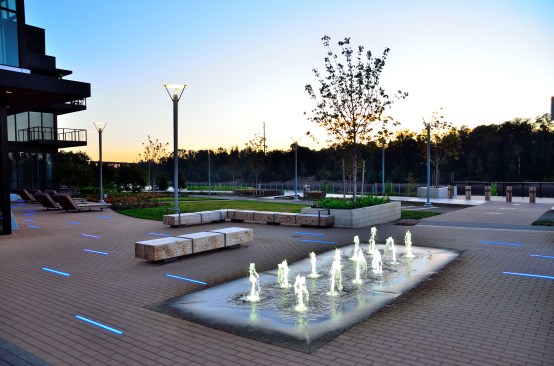
The water feature at Willamette Tower in Portland, Oregon.
At Willamette Tower in Portland, Oregon, we designed and built a water feature that enhances an outdoor community space with LED lights and water. While the bubbling fountain is a small area in comparison to the entire property, we took care to minimize splash within the 8-by-20 area. The water then flows through the jets and disappears between the joints and returns to an underground storage tank, where it is recirculated for continued use.
This same property was designed with sustainability and wellness in mind, so it also features smart-home systems and energy-efficient appliances in each unit, as well as an outdoor amenity deck, an enclosed dog run, and easy, direct access to an expansive greenway trail.
How can owners and operators retrofit older multifamily properties to add sustainable features that appeal to today’s renters?
When it comes to sustainability, you don’t necessarily need to go big to make a substantial impact. Consider replacing older materials with newer, eco-friendly designs and materials, such as flooring, water purification systems, and smart monitoring.
A community garden is a valuable and sustainable amenity that also offers social connection with other residents. It doesn’t take much to get a garden started, and, if it’s placed in a central location, can be a perfect spot for residents to gather and socialize.
In addition, a virtual wellness program is an added benefit that can be enjoyed by residents at any time. Some communities offer complimentary online wellness programming, such as fitness classes or meditation workshops, that set them apart from the competition.
What should owners, operators, and developers of multifamily properties consider about amenities as they look to attract and retain residents in 2026, and beyond?
First and foremost, consider amenities that will drive both resident satisfaction and operational value. Amenities that add convenience and save costs for residents should be at the top of the list.
The next consideration should be centered around the location of the property. What are the conveniences or community-building offerings that locals would appreciate? What are the sustainability concerns of the surrounding area? It is also wise to consider what other nearby properties offer in their amenities. What is missing in the market that residents would value?
Last, it’s important to investigate what technology is available to help streamline efficiencies and improve the resident experience. Is that technology well-tested and scalable to account for future updates and growth?
Ensure that the overall budget includes regular amenity maintenance to keep everything fresh and functional. Whether it’s a water feature, a community garden, or a state-of-the-art fitness center, regular maintenance is key to retaining the value of the amenities you provide.