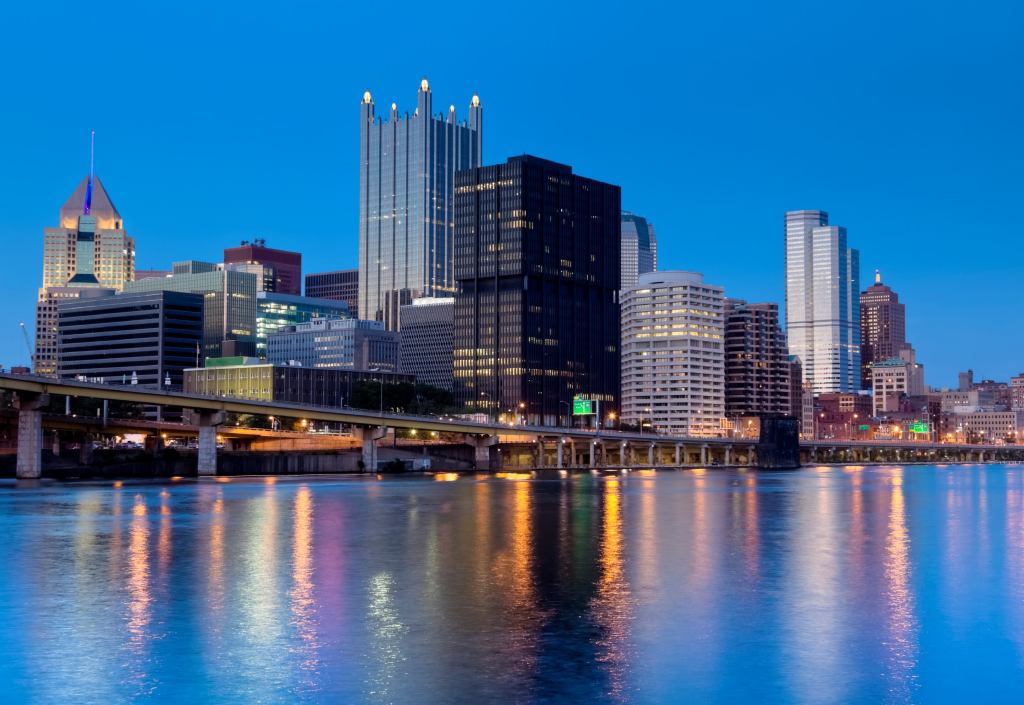
FAST FACTS: Pittsburgh
POPULATION: 2,356,285*
MEDIAN AGE: 42.6*
MEDIAN HOUSEHOLD INCOME: $46,212
AVERAGE MONTHLY RENT: $913†
OCCUPANCY: 96.7%†
UNEMPLOYMENT RATE: 7.4%†
Notable: Pittsburgh is home to a number of famous firsts: It built the first Ferris wheel (before sending it to Chicago), established the first commercial radio station, and hosted the first retractable dome. A “Pittsburgh Salad” is any salad topped with french fries. Famous Pittsburghers include Andy Warhol, Christina Aguilera, Henry Mancini, and several NFL quarterbacks, including Joe Montana and Joe Namath. A McDonald’s franchise owner in Pittsburgh named Jim Delligatti “invented” the Big Mac hamburger in 1967; it was distributed nationally beginning in 1968.
* Includes entire Pittsburgh metropolitan area
† As of Q2 2011
Sources: Greater Pittsburgh Convention & Visitors Bureau; MPF Research; U.S. Bureau of Labor Statistics; U.S. Census Bureau
Despite the large student presence, there’s very little institutional-grade apartment stock in Oakland or surrounding neighborhoods. Multifamily rentals in this area are predominantly smaller and aged by half a century or more. Locals report that high-quality vacancies are hard to come by. Of course, that’s also true even in Pittsburgh’s more-challenged neighborhoods farther east or in the southern sector.
In fact, for a city its size, there’s not much institutional-grade apartment stock anywhere in Pittsburgh. What is available is mostly located in and around the downtown area, such as the converted office towers bought by PMC Property Group. Factory conversions are also trendy. Outside of suburban areas such as Cranberry Township to the north, modern garden-style apartments are rare.
The most prominent exception is the 232-unit Morgan at North Shore, built in 1997 on the riverbank across from downtown and next to PNC Park, home to the Pittsburgh Pirates baseball team, in a revitalized part of town. That property was sold by Lincoln Properties Group to Morgan Communities in December 2009.
With occupancy rates always tight and institutional properties so rare, it would seem Pittsburgh might be primed for more development. But there’s good reason for the lack of developer interest. For all its positives, one thing Pittsburgh is not is a growth market. Yes, it successfully recast its image and avoided falling into the depressed state of other Rust Belt metros such as Detroit, but Pittsburgh still has its challenges. Chief among them: Its population is aging, and its numbers are slowly fading. Allegheny County (of which Pittsburgh is the principal city) saw its population drop from 1.33 million in 1990 to 1.28 million in 2000 and 1.22 million in 2010, according to the Census Bureau. At 42.6 years old, the median age of residents in the Pittsburgh metro area tops the U.S. average by more than five years.
For these reasons, Pittsburgh’s apartment sector is unlikely to continue ranking among the nation’s leaders for rent growth. But Pittsburgh has its place in the national spectrum. It has overcome the roller-coaster cycles of sharp growth and steep falls. Pittsburgh’s niche in multifamily is as a stable market that should underperform the U.S. averages in boom times and outperform the norms in rough times.