

A recent report by CBRE documents the level of foreign investment in U.S. multifamily properties and reveals a 27.3% drop in portfolio deals in 2019. Last year clocked in with a total of over $10 billion as compared with 2018, which was over $14 billion and off the charts.
The firm discounts the fall and instead points at a different and a more positive data point—the numbers for single asset deals as opposed to portfolio transactions. “For single-asset deals—a better measure of investment momentum because of less volatility from year to year—inbound capital increased by 3.8% to $6.1 billion,” per the report.
Most of the incoming money came from the usual suspect, Canada, which accounted for more than half of the inbound multifamily investment volume. Bahrain, Israel, the Netherlands, and the United Kingdom rounded out the top five.
The largest buyers were investment managers who took care of 33% of the transactions. Property companies took a 22% share, while equity funds and institutional investors followed with 20% and 17%, respectively.
CBRE
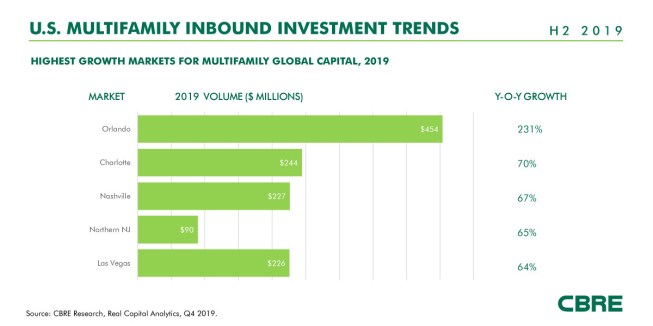
The highest growth market was Orlando, which registered a 231% gain. The top five markets measured by total volume include Washington D.C., Atlanta, Austin, Houston, and Los Angeles. The most powerful magnet for global investors was jumbo-sized deals. Almost half the cross-border capital bound for U.S. multifamily last year was targeted at assets priced higher than $200 million.
Overall, the percentage of global investment compared with the total of U.S. commercial real estate has gone up but remains relatively low. In 2009, foreign investment accounted for 4% of the $18 billion market. Ten years later, the numbers are 6% of a $180 billion market.
Measuring since 2015, the most popular markets for global investors have been New York, Atlanta, Washington, D.C., Dallas/Fort Worth, and Los Angeles, in that order. The preference for buying into building types goes to garden-style, which leads 65%, to 35% for mid-/high-rise in the domestic arena. The numbers are nearly identical for global.