

They say, to err is human.
Human error, as you may know is the subject of a whole branch of science, and this make a lot of sense, as it would be helpful for many of us to understand why we’re so prone to messing up. Individual persons, the Nobel Prize-winning psychologist Daniel Kahneman and his associates noted, are susceptible to judgment error.
Judgment error, Kahneman notes, tends to spring from two separate but equally important sources, bias and noise. In looking at how individuals’ tendency to make mistaken judgments and base decisions on those wrong assessments rolls up into group behavior, Kahneman’s work sheds light on multifamily business leaders’ challenge with rent control and its cost.
More than that, it might enlighten a pathway for action.
This analysis in Medium by J. Nathan Matias may be a helpful way to cue this up:
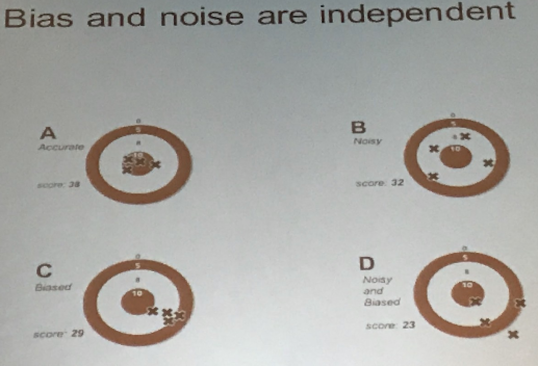
Noise, Danny tells us is like arrows that miss the mark randomly, while bias misses the mark consistently. Bias and noise are independent and shouldn’t be confused. Something can be both noisy and biased. People frequently think that noise cancels out, because the mean tends toward zero. This isn’t true; the standard measures of error in statistics add up. Both bias and noise are additive.
Now, think of the issue of rent control, its root motivations, and how it gains currency and sway in communities. It traces to an error in judgment about how to apply policy to bridge the gap between peoples’ means and housing options. It then rolls up into an issue that allows politicians an opportunity to grandstand and use to gain votes. We’re going to focus on rent control as an all-encompassing, all-important opportunity area for action at our upcoming Multifamily Executive Conference, Sept 17-19, at the Las Vegas Bellagio. Register now. It’s just three short weeks away. As National Multifamily Housing Council president Doug Bibby notes:
We understand the appeal of rent control. Local and state lawmakers, driven by the urging of constituents, campaign promises, and short terms of office, are looking for expedient policy solutions to help them address housing affordability issues in their communities.
What these well-meaning politicians and citizens don’t realize is that rent control is not a cost-free policy, and it’s certainly not a panacea. Lawmakers would have more success if they fully understood the specific problems facing their communities and then were to apply policy levers that respond to those challenges.
Now, Bibby and many of the multifamily business community’s leaders believe that now is a critical moment for action to address both the bias and the noise that flow into why rent control is snow-balling as a challenge for the industry.
Bibby notes,
Public and private stakeholders have a responsibility to come together to find ways to both build more housing and reduce housing costs. Policy solutions should be unique to communities and the precise drivers of housing affordability challenges. An approach that is effective in California is not likely to have the same impact in Texas.
There is no single policy remedy that will ease housing affordability across the U.S.; we will need a comprehensive and nimble approach. However, decades of research, case studies, and on-the-ground experiences have proved that rent control—far from improving housing affordability—deepens the problem and results, at best, with only kicking the can further down the road.
Short-, medium-, and long-term project-level action plans need to reflect tactics and strategies to address both bias and noise as sources of error, both individually and among bunches of people who vote for and validate policy.
To help triangulate and clarify on how and where your action can be most effective, we’ll have the NMHC’s Doug Bibby and Jim Lapides, vp of strategic communications, lead a conversation on both what’s happening on the rent control front, and what you can and need to do about it at the MFE Conference on Sept 17. Click here to register.
