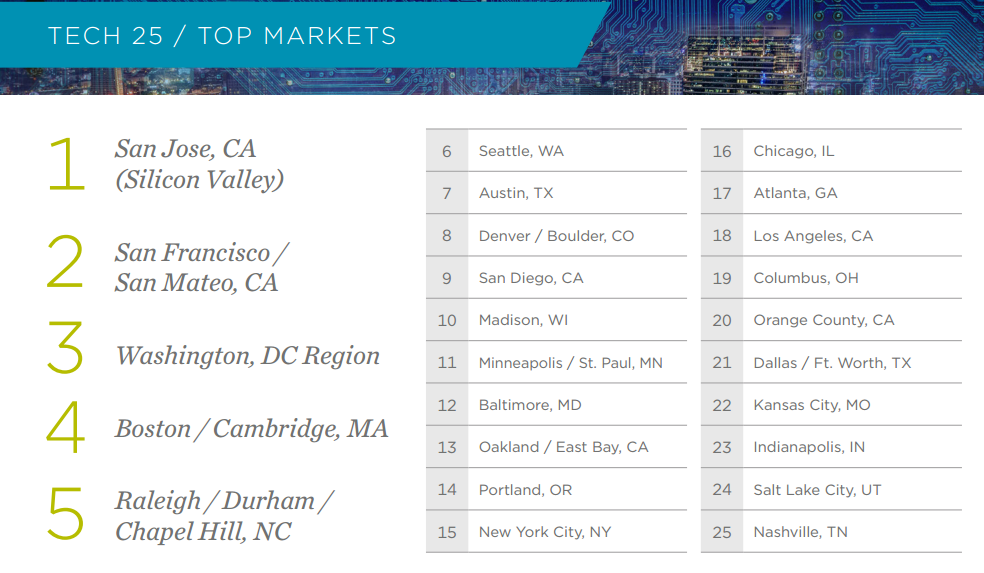
San Francisco, Silicon Valley, and the greater San Jose area are well-known tech hubs in the U.S. The jobs the tech industry has created in those markets has driven rental and home prices to new heights in recent years.
But in Cushman & Wakefield’s inaugural “Tech Cities 1.0” national report launched Thursday, an unlikely city was ranked as the third-best tech city: Washington, D.C.
“There is tremendous access to high-level universities such as University of Maryland, Georgetown University, The George Washington University, George Mason University, University of Virginia, and Virginia Tech University, and this translates to lots of young talent that does not have far to go from their respective colleges to find jobs in tech,” said Theo Slagle, director, Cushman & Wakefield, in a release.
A dominating hub for life sciences and government, Washington, D.C. also serves as a significant outpost for tech companies seeking proximity to policymakers as well as for burgeoning cybersecurity investment, the firm said. Washington, D.C. houses an established hub of well-known tech companies such as Facebook and Uber’s East Coast headquarters, and Amazon, and Google have a very large presence on Capitol Hill.
“There is access to smart people and an educated workforce,” added Slagle. “Instead of choosing a law firm, for instance, many of them are choosing to work in-house for a tech company like Amazon and be part of the legal team.”
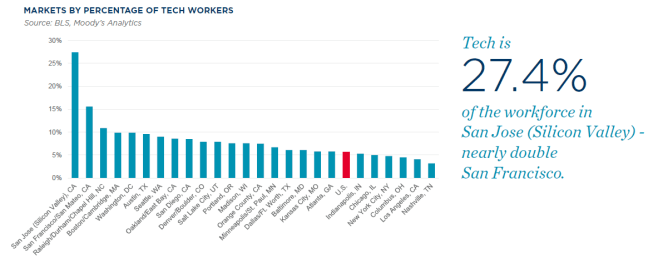
The top 25 tech cities were determined by analyzing the concentration of factors the Cushman & Wakefield refers to as the “tech stew,” such as talent, capital, and growth opportunity.
Courtesy Cushman & Wakefield
“Basically every company today is a tech company in one way or another,” said Ken McCarthy, Cushman & Wakefield’s New York-based principal economist and applied research lead for the U.S., in a release. “We’re all using it, we’re using various aspects of tech companies to do various things.
A Closer Look at Seattle
Robert Sammons, report co-author and Regional Director, Northwest U.S. Research at Cushman & Wakefield in San Francisco, said that while it was not surprising to see San Jose (Silicon Valley) and San Francisco continue to dominate, that mass-transit issues and escalating housing costs in those areas have fanned a tech spillover into secondary markets such as Austin (no. 7), Denver (no. 8), San Diego (no. 9), and Salt Lake City (no. 24).
Sammons said Seattle, which ranked sixth on the list, is one of the biggest, if not the biggest competitor to Silicon Valley and San Francisco. :Seattle is an interesting case because it was driven by Microsoft early on, which endures, and now Amazon is huge in the downtown area and it continues to be significant.”
He pointed to tech titan Google, which continues to spread its wings outside of Silicon Valley, for opening operations in Seattle to entice the existing talent pool. Sammons cited Seattle’s cost-of-living as a lingering issue, somewhat mitigated by a recent uptick in residential development that’s outpacing San Francisco’s, as well as mass transit challenges.
“Seattle has played catchup over the past few years but with housing creation now outpacing that of the Bay Area and with a huge $54 billion transportation initiative that recently passed at the ballot box, it will likely allow it to compete much more aggressively with those markets at the very top of the list,” Sammons added.