
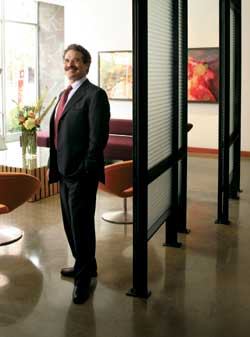
Deal Makers
“Everyone kids Ronnie that he talks too much. Ronnie’s cell phone message is, ‘You’ve reached the offices of Ron Ratner. At the tone, please start listening.'”
–Chuck Ratner
Ratner’s energy is coupled with a charisma and a gift of gab that helps the company get its always-ambitious projects off the ground. A vast majority of Forest City’s projects are developed through public/private partnerships, which requires the developer to work with localities, universities, and other public institutions to secure zoning and permitting approvals and maximize economic incentives and tax-exempt financing.
Ratner, who has been working with public entities for decades, has developed a real knack for community development work. “He is good at communicating,” says Rich Moore, a real estate analyst at RBC Capital Markets. “He’s very dynamic and a very excitable guy.” And he’s equally knowledgeable. “When Ron walked me through Stapleton, his knowledge of what was going on was very extensive,” adds Moore. “If you take a project of that size and understand it the way he clearly understood it and was able to communicate it to me, that has to be a plus when you are trying to work with government entities that want to understand why it’s important that they shell out financial assistance to you.”
Forest City doesn’t usually have too tough a time convincing cities to form a partnership, as the company helps cities with neglected properties or difficult projects that other developers might deliberately ignore. “Because these guys are the best at doing [urban projects], the city has a huge interest in lending a hand,” says Moore. Plus, Forest City’s core philosophies and business strategies as a long-term property holder and a financially transparent public firm align well with cities’ needs. One such case: At Stapleton, the city was looking for a major national developer with a long-term commitment to ownership, mixed-use talents, and the ability and desire to work with a neighborhood development corporation and citizen advisory board. Forest City fit the bill perfectly, says Ratner.
To get its frequently complicated projects done, Forest City relies on a host of financing tools: federal and state historic tax credits, low-income housing tax credits, and, quite often, federal tax-exempt bond financing, which generally requires developers to make 20 percent of the units available to residents earning 50 percent or less of the area mean household income. And, whenever possible, the company will combine these types of financial incentives to make the deal work.
That’s what it did with Sky55, a 411-unit apartment high-rise in Chicago. The city offered Forest City a 50 percent abatement of real estate taxes in exchange for making one-third of the units affordable. “Cook County happens to have the highest rental real estate taxes that we pay anywhere in the country, so while the 50 percent abatement is usually significant, the income loss was [still] staggering,” explains Ratner. By obtaining bond financing for the deal, Forest City was able to recoup some of that lost income.
While Ratner readily admits that an affordable component can make a project’s numbers pencil out, he sees much more than a simple math equation. Providing housing for all socioeconomic groups fits the company’s overarching philosophy. “We just believe we have a commitment to do affordable housing when we’re working in urban environments,” he says.
And knowing Ron Ratner, he’ll personally ensure that Forest City does just that. “As a leader, I am someone who really plunges in,” he says. “I tend not to just stand on the side of the lake and say, ‘OK, you swim here, you swim there.’ I jump in and say, ‘There’s an island out there in the lake, let’s get there.'”