
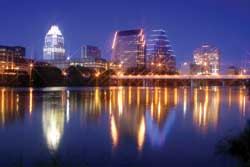
Austin Rising “In the years of the 1970s and 1980s, Austin relentlessly pursued job creation,” says Sperring. “The city got major companies to adopt an Austin address and built a corporate base that now powers the community.” They include Applied Materials, Dell Computers, and Motorola.
The biggest thing going for Austin, however, may be the stabilizing effect of being both a capital city and a college town. Austin is home to the University of Texas, which has the all-important employment base and one of the largest student populations in the nation. Growth in these public and private sectors carried Austin’s economy into its golden years of the 1990s.
Then, in typical Austin style, the market shifted.
It took awhile for multifamily owners to feel the pinch, though. In 2000 and 2001, the multifamily pipeline was still roaring, with 12,000 new units built in Austin annually. By 2001, both occupancy and rental rates were declining. The average apartment in Austin was renting for $743, and occupancy was 88 percent. New product was giving three months’ free rent on a 12-month lease.
Austin Today Most experts speculate that while current conditions may not be the absolute bottom of the Austin multi-family market, they are very close. As of mid-2004, Austin rents still suffered from pent-up concessions, but construction had slowed to 2,319 new multifamily units. By late 2004, local apartment owners were witnessing their first signs of stabilization in years.
According to the Austin Multi-Family Trend Report, which is published by Austin Investor Interest, occupancy in the third quarter 2004 rose a full 2 percentage points to 90.81 percent, reaching its highest level since 2002. Effective rents also ended an 11-quarter decline, rising to 81 cents per square foot. The average rent was $669 for 825 square feet. The average sale price per unit was $66,852, or $71.70 per square foot.
Rental rates are expected to move upward, but not until Austin is able to burn off a ton of giveaways. On the investment front, buyers and developers are looking forward with great promise. Five new properties have recently broken ground, and nine have been submitted for permit, says the report. A number of large and recent multifamily deals in Austin indicate that there are investors looking to get back into this market as well.