
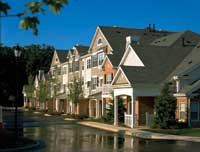
Regional Approach Not only are architects designing better looking, more functional apartments, but they also are designing communities with a geographical area in mind as well. “Developing an historical style is very appropriate today,” Buster says. “People like to identify with a theme, whether it’s classical, or French country, or Mediterranean, or Spanish. It’s important for people to be able to associate a name with where they live.”
Those themes often spring from the area’s history and culture. “Depending on what part of the country you’re in, the historical architecture of that region is the dominant style right now. You can go from Texas to Florida to the Midwest and find styles that are very authentic to that area,” Buster says. “In the South, for example, breezeways are replacing hallways. In the Southeast, the focus is on a Mediterranean look. We’re also seeing styles like ‘low country,’ a style reminiscent of homes found in the low country of the South, which feature pillars and front porches, and what is referred to as the ‘Florida cracker’ style with metal roofs and stucco, which is very popular today. In California, we’re doing a lot of Tuscan architecture.”
Other points of emphasis in today’s apartment communities include trim details along doors and window frames; lighting; varying roof lines and heights; and entry monuments. Turrets, gables, bay windows, dormers, and balconies with wood railings have also helped breathe new life into apartments while softening the overall building’s appearance.
“Apartment buildings used to be vanilla. But today, we’ve figured out that there is no reason not to develop as if we are building a single-family home. We have a growing number of communities, like Orchard Village in Aurora, Ill., and Southwest Crossing in Naperville, Ill., that have features you used to only associate with single-family living, like individual garages and private balconies,” says Tony Rossi Sr., president of Chicago’s RMK Management, which manages more than 6,000 Class A apartment communities in the Chicago and Minneapolis areas.
Premiums are also being placed on landscaping throughout apartment communities, especially within garden apartment living. Adding more greenery– grass, bushes, and trees–creates a more inviting environment as do gardens, flowerbeds, potted plants, and water features. Lakes enhance apartment views and may revitalize formerly bland communities. And many management companies are more than happy to accommodate renters with this amenity, given that they can place a premium on units with lake views.
While apartment architecture has undergone a considerable facelift in recent years, developers, architects, and designers can’t take all of the credit. City planning departments are also responsible for today’s architectural trends.
“Cities have a major impact today because without their approval, the project doesn’t get done,” Buster says. “Council members are looking specifically for an upscale product. An institutional look won’t do. Cities have definitely raised the bar: They want details in the entries, details in the windows, details carried throughout the community.”
In Naperville, Ill., where RMK has three communities, city planners mandate that at least half of the masonry materials used for constructing multifamily housing be brick. The city also has a ban on exterior insulating finishing systems and requires that at least 35 percent of an apartment community be dedicated to open space, says Mike Schwarz, a community planner for Naperville.