


Next generation design may conjure images of spiral towers that reach forever into the sky in your mind’s eye. But is that realistic? Where is next generation design headed? What are the realities from costs to performance?
The 2017 Multifamily Concept Community attempts to answer these pressing questions. This next generation project studies processes and products that can help close the gap on code, land, labor, and material challenges by shaving time and cost from the construction process.
BGO Architects and JPI are combining their expertise to create a forward-thinking design, development, engineering, and construction program that unveils thought leadership for the next generation of construction.
Minho Kim, partner and chief design officer at BGO Architects, says that the focus is to adopt building technology controls that are smarter and better quality. Kim and his partner, Erik Earnshaw, have targeted modular construction as the most obvious next generation approach. But first, Kim says, there will need to be a paradigm shift.
Earnshaw and Kim have started thinking about a new way to talk about modular that doesn’t bring with it the perception of cheap or low quality and that touts the many benefits that it offers. For instance, Kim points out that modular construction sets a clear path for repetition, which saves time, money and provides better built quality and quality control.
Other organizations also are fighting that stigma. Tom Hardiman, executive director at the Modular Building Institute (MBI) explains that his organization is constantly striving to reach and educate commercial construction professionals. In early 2015, the MBI Board of Directors embarked on a mission to focus resources and efforts on the goal of increasing the market share of the commercial modular building industry from its estimated 2.5% to 5% percent of all new construction starts by the year 2020. Essentially, this means doubling the market share during the next five years.
Hardiman says that MBI also is developing specific plans to address and minimize regulatory barriers, maximize exposure, and identify relevant trade shows, speaking opportunities, and professional development needs. He says that the more education that is provided to end users, the more acceptable modular will become in the construction industry.
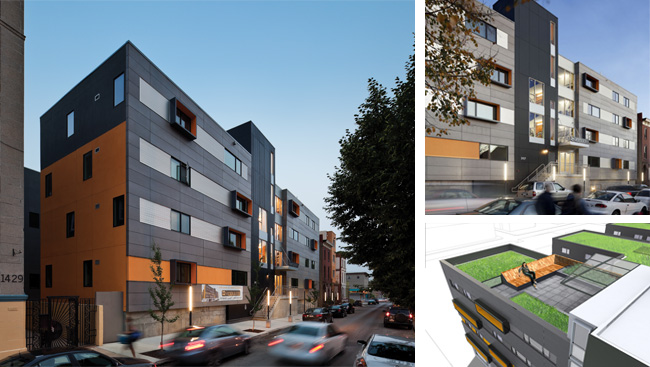
The Modules at TempleTown
He says that it also cuts down significantly on waste so it’s a much more sustainable construction path.
The design team at BGO Architects thinks one critical element of the design will be flexibility. Kim says that today’s renters are more demanding and each want something that uniquely responds to them. Kim translates these demands into different kitchen modules that can be plugged in depending on the specific renter’s desires. They will offer up to four kitchen modules for one unit that the renter can shop as an option.
Another way that BGO will offer flexibility is through a DIY entry shelving system that includes a coat closet, a mudroom bench, storage and a washer and dryer that the tenant can design specific to their needs.
Kim feels that responding to consumer demands is just as obvious as responding to the need to be sustainable. He says that it’s no longer an option, this next generation design should be net zero and the modular system that they imagine will help them achieve this. Because it is prefabricated, it his higher quality and the energy performance is better. It is created in a controlled system and contributes to net zero.
Not only that, Hardiman explains how job site waste is minimized by prefabrication. He says that modular manufacturer can purchase materials in bulk and have them arrive at the factory. In a factory, only the material needed for the module construction is used, and anything that remains can be stored for later use. Whereas, during stick built construction, excess material often ends up in the dumpster headed to the landfill.
Factory built can also mean less vehicular traffic to and from the job site. And, Hardiman validates Kim’s thoughts that the quality control assembly in the factory allows for a tighter and more energy efficient building envelope.
To put all of this into numbers, Hardiman says that traditional construction methods account for an estimated 25 to 40 percent of the national solid waste stream, with only 20 percent of that waste being recycled. By using offsite building methods on a project, there could be a 90 percent waste reduction.
Another incredibly important element of the construction that Kim highlights is the need for “future proofing.” BGO architects wants to steer clients toward a design and construction method that are a solid long term investment. He says that using modular is one great way to provide that and to lower the overall costs.
Hardiman points out that with modular construction, there is a shorter construction schedule, which is a way to hedge against material price increases. Plus, with labor a major concern for builders, modular factories can also help prevent against labor shortages. Factory workers show up at the same location daily rather than traveling from job site to job site.
“Lastly, with modular construction, the key design elements must be worked out and agreed upon in the initial phase of the project, minimizing costly and timely change orders in the future,” Hardiman says. “There is a point in the dialogue where the parties must agree to a “design freeze” because once the factory begins work, the actual construction of the building occurs rather quickly.”
Follow this project online now and at the Multifamily Executive Conference, including an in depth look at strategy, tactics, sourcing, and specification, collaboration, innovation, communications, and marketing that drive thought-leadership around next generation developments.