
To calm residents and gain their support, Seymour and others at SoCal essentially went door-to-door to assuage resident concerns as well as garner a better sense of the property’s condition. They held community forums and city-sponsored workshops. Those efforts paid off. Not only did 75 percent of the original residents remain after renovation, but some of the strongest opponents are today some of the complex’s best volunteers, helping out at after-school programs, teaching adult education programs, and raising money for community activities.
The second major challenge was purchasing the properties, which was no small feat given that 16 different entities owned the 18 parcels. While most sold, other parcels had to be threatened with eminent domain by the city. It took nearly three years to complete the purchase of the property.
With so many owners, SoCal couldn’t gain access to all properties before submitting cost estimates, hiring crews, and lining up funding. So its construction mangers had to estimate the project’s scope just based on what they could see, explained Ashley Wright, SoCal’s director of project development. “Many of the units were Band-Aided together and barely functioning as decent rental housing,” he recalls.
“We’ve done a lot of rehab over the years, and it’s always a surprise when we see the condition of these things,” said SoCal construction manager John Taylor, who says the condition of Shadow Hill surpassed even his worst fears. The site itself yielded more surprises, recalls Seymour, all of which significantly impacted the project’s budget. Drainage problems required new retaining walls and regrading of the entire site. New curbs, gutters, and, in some areas, streets were needed, while existing slopes had to be modified to conform to Americans with Disabilities Act requirements. And the discovery of a 68-inch city water line along the front of the site meant a 300-square-feet concrete slab to protect it while the front parking lot was replaced.
The result? Not only did SoCal give up its developer fee, it sank its own money into the project, funds it doesn’t expect to recoup for at least 30 years, says Seymour. “I truly believe that if the SoCal Housing leadership didn’t make the decision to move forward even though we were losing money, Shadow Hill never would have been completed and the city would have been left holding the project.”
All told, it took 18 months to secure financing from eight different sources, the largest number of lenders ever on a SoCal project. But it was worth it.
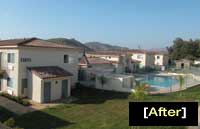
With the changes in the physical structure of Shadow Hill have come changes in the attitudes of its residents. “You can see pride come back into the faces of these families,” Minotti says. He recalls how one resident would never invite his family over because he was so ashamed of his surroundings. “After the renovation,” said Minotti, “he held a huge family reunion in the community center. He was so proud of his new home.”
–Debra Gordon is a freelance writer in Nazareth, Pa.