





Paul Hester
CAMPUS LIFE: Once an abandoned industrial lot, the Hope for Have…
Texans think big, and Bill Greehey has clearly mastered that skill since moving to the state from his native Iowa 57 years ago. The former chairman and CEO of San Antonio–based Valero Energy Corp., one of the country’s most successful oil refining companies, Greehey certainly understands the needs of big business.
But as he neared retirement, Greehey wanted to do more to give back to his adopted city. In 2004, he set up The Greehey Family Foundation to improve community health, welfare, and education in the local market.
He didn’t stop there. Upon seeing a television program about the homeless, Greehey decided to assist this disadvantaged sector, as well. “[The TV program] showed the faces of the homeless and how their root causes weren’t being addressed,” Greehey recalls.
He decided to do something about the problem, and, with typical Texan largesse, he has.
A Splendid Rebirth
Starting in 2007, Greehey began rallying public and private funds and, with the support of former San Antonio mayor Phil Hardberger and a core of experts, studied firsthand the country’s homeless shelters. As a result of the team’s efforts, four years ago Greehey broke ground on the transformation of a blighted, 37-acre industrial lot. The swan that emerged three years later, Haven for Hope, is a $101 million, vibrant model campus where homeless residents can learn to become self-sufficient, active members of their community.
“Most cities think they’re doing a great job if they feed and clothe the homeless, but they’re not,” Greehey says. “We’re putting them through a program to become drug- and alcohol-free and live independently.”
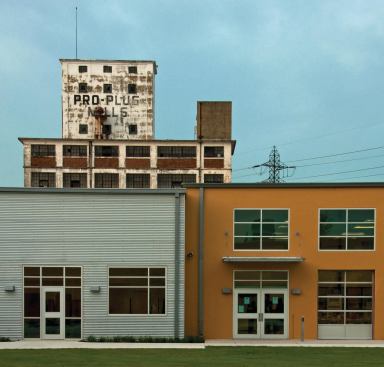
The site’s 12 former warehouses and six new buildings serve as a lively, colorful mix of dorms, classrooms, medical facilities, and play spaces for 1,400 homeless men, women, and children. Meanwhile, 81 partner agencies provide 150 different services for the facility—from a Boys & Girls Club to the Christian Dental Clinic and a Dress for Success shop. Homeless residents stay as long as they need to in order to make the transition to independence.
The money that funded the facility came from a variety of sources, says Steve Oswald, Haven’s CFO: $20 million from the city of San Antonio; $11 million from Bexar County, San Antonio’s home; $6 million from the state; $3 million from in-kind contributions; and $61 million from Greehey’s fundraising efforts and personal funds.
To design Haven for Hope’s campus, Greehey hired locally based Overland Partners, Architects, which has expertise in developing master plans and has begun to establish a reputation as an expert in homeless design since the creation of its award-winning Bridge, a $21 million, city-owned homeless assistance center in Dallas.
“We wanted Haven to look and feel more like an apartment or college complex instead of a homeless shelter,” says architect James Andrews, “which meant low two- and three-story buildings with high ceilings, windows, light, and bright colors.”
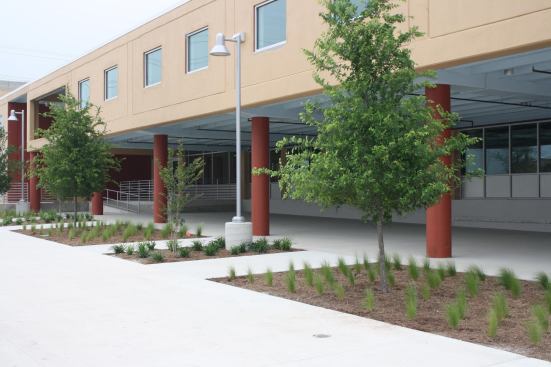
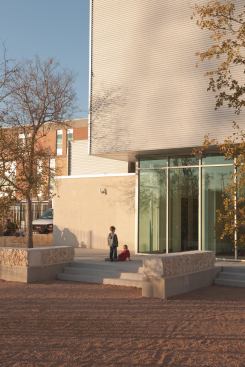
Local landscape architects Bender Wells Clark Design (BWCD) cleaned up, humanized, and redesigned the former industrial site to include drought-tolerant native plants, shade trees, space for a community garden, a central green area, limestone seating, drinking-water fountains, signage, and even a kennel for residents’ dogs. There’s also a “Prospects Courtyard” for the chronically homeless to sleep and eat outdoors before they “graduate” to the main campus if they meet the qualifications.
Throughout the acreage, BWCD knew to design uninterrupted views. “We wanted the outdoor spaces to feel comfortable and safe, and be overseen easily by staff,” says firm principal and vice president Lawrence C. Clark.
Campus rules dictate frequent drug and alcohol testing, and a mini-rehab clinic offers a 90-day program for those needing such services. Campus staff and volunteers are kept to a minimum so that residents can actively help manage the community themselves. A culinary program through the San Antonio Food Bank, for instance, provides training for 16 new chefs every eight weeks to prepare 3,000 daily campus meals, says George Block, Haven for Hope’s CEO.
Lessons Learned
The team behind Haven for Hope attributes the facility’s success to four key points.
Be prepared for the unanticipated. With the economic downturn, the number of homeless people—especially families—increased, says architect James Andrews of Overland Partners, Architects. “We had been biased toward thinking there would be a larger proportion of men. But within days of opening, the family building was overflowing. We had to resort to our contingency plans [to adjust the space] to accommodate the overflow,” he says.
Expect greater challenges and costs. Transforming abandoned industrial buildings into live/work, medical, dental, and other high-traffic facilities requires careful attention to stringent building codes and accessibility guidelines. “Be sure you estimate properly [the money needed] and set aside sufficient funds,” Andrews says. Also, he adds, make sure you know how the spaces will be used and leave room for adapting them.
Use landscaping to make community spirit bloom. Greenery and open space help inspire a sense of calm and relaxation, which is important for people who are trying to transform their lives, as well as for those individuals who work in the setting. “We knew to keep it simple, uncluttered, and flexible, since the users wanted to spend time outdoors,” says Overland principal and vice president Lawrence C. Clark. Adds George Block, Haven for Hope’s CEO: “The main green space now resembles a college quad with people playing guitars and throwing footballs.”
Go the next step. With 5,000 homeless families in San Antonio, Haven knew it needed low-income housing, too, in addition to the temporary quarters it offers. “We’re encouraging developers, if they’re building an apartment complex, to save a few [units] for low-income residents,” Block says. “The goal should be to build real communities where some who are just setting foot on the rungs of the economic ladder can live.”
By disseminating information to neighborhood residents early on, the city’s Department of Community Initiatives gained support for Haven. “To overcome some objections, the design was tweaked to place family and female dorms close to the neighborhood and the most chronic homeless next to the industrial area and county jail,” says Melody Woolsey, the department’s assistant director.
Because of Haven’s recent debut, hope and a second chance at a new life have increased. Take the example of Magan, a resident who came to Haven with her husband and two sons after losing her job and is now obtaining the skills she’ll need to regain her medical administrative license. “My older son had a hard time when we came,” she says, “but he’s getting counseling and coming around.”
Continuing the Transformation
Since it opened in April 2010, Haven for Hope has helped 200 individuals move from homelessness to independence. In addition, representatives from more than 190 cities have toured the campus, giving hope to Greehey that his facility, which recently received the prestigious American Institute of Architects “Special Housing” award, will help transform the lives of other homeless individuals throughout the country as well.
But Greehey isn’t just concerned with how the homeless fare during their time at Haven: He knows that many graduates will need affordable housing once they leave the campus. To that end, Greehey is currently fine-tuning plans to establish low-income housing on eight acres adjacent to Haven.
“We expect to break ground this summer for a 140-unit building on four acres at a cost of $15 million, then do another building on the remaining land,” says Greehey, who continues his large-scale efforts not only as chairman of Haven for Hope’s board, but also as chairman of San Antonio–based NuStar Energy, a supplier and transporter of asphalt spun off from Valero Energy in 2007.
It seems San Antonio will long continue to benefit from Bill Greehey’s big ideas and larger-than-life efforts.
Barbara Ballinger is a contributing writer based in Rhinebeck, N.Y.