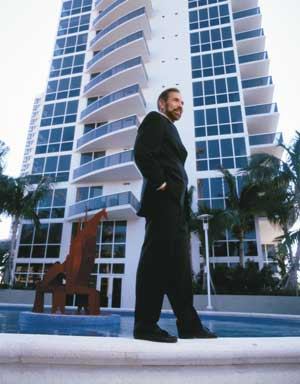
Calculated Risks Despite his penchant for being the first to market in some high-risk areas, such as a West Palm Beach area that was surrounded by lower-income developments, Perez surprisingly says he avoids risk. He learned this lesson as a child coming from a wealthy family that fled Cuba when Fidel Castro gained power.
After seeing how easy it was for his parents to lose everything, Perez does not want to take unnecessary risks. His condo development strategy is a good example of his conservative approach. Because he often goes into uncharted terrain, he wants 50 percent to 60 percent of condos bought before he starts to build.
This leads to lengthy pre-building process. Perez spends $3 million to $5 million on marketing before he buys the land. So far, he has not had to walk away from a project, but he says he is prepared to if the numbers don’t work.
While this may seem like a lot to spend on marketing, he says it’s much better than the alternative. “It is much worse to spend $100 million and realize you aren’t selling,” he says.
Not every company has the track record and resources to employ this strategy, says one of Perez’s longtime bankers, Adolfo Henriques, group CEO of Union Planters Bank in Miami. “By the time they are that far into a project, a lot of people have no choice but to move forward,” he says.
Perez’s fear of not being able to meet his absorption rates on condo deals affects his pricing strategy. He readily admits that he will ask for about 10 percent less than he could probably get for his units because he wants the peace of mind of knowing they are all sold.
“If we look at a market, we try to price ourselves at a point where velocity of sales is more important than profitability,” says Perez. “People always tell me that I am leaving money on the table, but I want to make sure I go to sleep at night knowing that a building is sold. Risk is a very important factor for us.”