
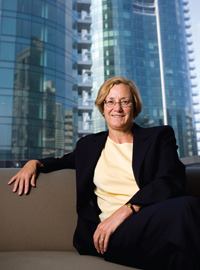
Despite her ability to dispense with strategic hesitancy, Galante is certainly not a my-way-or-the-highway despot, choosing instead to push initiative downward through the organization rather than making the final call on every single corporate move. “Again, we are balancing the desire to create an organizational framework for people but emphasize ownership of the deal,” Galante says. “We have informal check-in points, but basically, you find it, you put together the architects and contractors, and you live with that deal until the keys are turned over to the property management company. That’s how people feel ownership of the projects they are working on.”
Still, Galante admits to relishing an opportunity to get personally involved in projects when she can, particularly during the entitlement process. Case in point: Cottonwood Creek Apartments, a $27.5 million, 94-unit garden-style affordable community in Suisun City, Calif., that had its grand opening last month. Galante helped to spearhead financing and ease the entitlement process for the property, working in partnership with Suisun City Mayor Pete Sanchez and the city council to issue revenue bonds that helped fund the project. Rents at the community range from $393 to $890 per month, a pittance for a Bay-area apartment that also boasts environmentally friendly features such as solar panels powering all common areas and water-efficient fixtures and appliances that help the property exceed California’s energy code requirements by 15 percent. “Working with BRIDGE has enabled us to make sure Cottonwood Creek has all the features and amenities needed for this brand new neighborhood to stand the test of time,” Sanchez says. “The terrific results speak for themselves.”
Credit Galante’s zest for working such politics of deal-making to a five-year stint in the City of Santa Barbara’s planning and community development department immediately after graduating from the University of California, Berkeley, with a master’s degree in city and regional planning. “It taught me how to find compromise and how to count votes,” Galante says. “It may seem simplistic, but you need those three votes out of five. It is an important lesson. It taught me how to understand that if you are going to approach doing large-scale, mixed-income, mixed-use real estate development, you have got to be able to get through the politics of a locality.”
POLITICALLY MOTIVATED If Phil Angelides had his way, Galante’s politics might not have been so local. The former California state treasurer ran a spirited though unsuccessful campaign for governor in 2006 against incumbent Gov. Arnold Schwarzenegger. Angelides’ first call had he been elected? “Carol’s would have been one of the first numbers I would have dialed in assembling my cabinet,” says Angelides, who now chairs the Canyon-Johnson Urban Communities Fund and is principal of Beverly Hills, Calif.-based Canyon Capital Realty Advisors. “Carol is outstanding and takes an immense amount of pride in what she does, as she should. BRIDGE’s communities are high-quality: They add to the urban fabric, and they provide great living environments for the families they serve. Galante hits on all pistons.”
Those comments come with a certain weight considering that Angelides’ Canyon-Johnson Urban Communities fund directly competes with BRIDGE for key investment dollars from the California Public Employee Retirement System (CalPERS) pension fund. Launched in 2000, the BRIDGE Urban Infill Land Development (BUILD) program was granted $100 million in CalPERS equity that was invested in seven mixed-income developments. In 2006, CalPERS followed up with an additional $75 million in equity to continue funding the BUILD program.
Despite the competition for dollars (the $1 billion Canyon Johnson Urban Fund III includes a $225 million buy-in from CalPERS), Angelides says BRIDGE can teach market-rate developers a thing or two about successfully executing mixed-income, mixed-use urban projects. “Carol has applied diligence in building an organization that serves as a model not just to nonprofit housing developers but [also] to for-profit providers,” Angelides says. “In fact, I pick up the phone often to consult with her and ask her advice. We want to take into the for-profit world the best-in-class examples that Carol has set at BRIDGE for the nonprofit world.”
Most notably, the CalPERS investments have enabled BRIDGE to partner with Oakland, Calif.-based McGrath Properties to develop the MacArthur BART Transit Village, a 29-acre, 1,500-unit community of market-rate homes, retail space, and affordable housing rentals that has been selected by the U.S. Green Building Council to be part of the LEED Neighborhood Development pilot program. Included in the Oakland, Calif., project is 14th Street Apartments, a 99-unit development by BRIDGE that will be reserved for working families earning between 30 percent and 50 percent of the area median income (AMI).
Just don’t explain it that way to Galante. “AMI. If there is one buzz word that I really don’t care for, it is AMI,” she explains. “Go ahead and talk to mayors and city councils and even neighborhoods about area median income, and just watch their eyes glaze over.” According to Galante, Terner and the other BRIDGE founders were always adamant in trying to lose the lingo, a trait she tries to carry forward in her own dealings with policymakers and the public. AMI has absolutely no meaning, Galante contends, whereas explaining that communities are for teachers or secretaries or plant workers carries much more weight with stakeholders. “Are you building for people who earn between $12,000 and $25,000 a year? Say that. Name the professions. Name the income ranges. People get that. That’s how you begin to master convincing people of the things that make sense.”
Galante’s skills in that arena were put to the test in 2006, when she co-chaired California’s Proposition 1C campaign and helped convince nearly 4.2 million registered voters to pass a $2.85 billion bond measure funding development for lower-income residents and development in urban areas near public transportation. The first award recipient under the program? None other than BRIDGE, which received $100 million from the California Department of Housing and Community Development on July 3, 2008, for seven projects qualifying under Prop 1C’s In-fill Infrastructure Grant program and the Transit-Oriented Development program. In total, the projects comprise 870 affordable units in San Mateo County and the cities of San Diego, Oakland, San Francisco, and San Leandro.
And who stepped up to the podium to laud Galante and announce dispersal of the first Prop 1C funds? Try Schwarzenegger himself, who pointed specifically to BRIDGE’s San Mateo properties, saying, “There’s nothing that I love more than to announce three things simultaneously, which is construction, new jobs, and projects for the people of California. [Prop 1C] projects will create 1,540 jobs, more than $70 million in wages and will leverage a total investment of $316 million. Right here, on this site, [BRIDGE] will break ground this year on 56 affordable apartments for very low-income seniors. It is all wonderful news for us here in California. We use bond money to leverage private investment, create action, create jobs and pump up our economy, and build affordable housing at the same time.”
