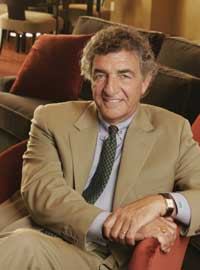
It’s a telling story about the CEO and the organization, which recently was named one of the best companies to work for in the Washington area by the Washington Business Journal. Employees describe their boss as loyal, a leader, a visionary, and “caffeinated” (because of his endless supply of energy). Sure, he’s got a temper and expects a lot. But Bozzuto also rewards his people in important ways. “He finds good people and he treats them respectfully and fairly,” Patterson observes. “He compensates his people well, and he motivates them both emotionally and financially. I really believe he cares about the people who work with him. Fundamentally, that’s one of the key reasons he’s as successful as he is.”
The company’s lenders notice this as well. “Tom and his partners have attracted very smart and motivated professionals to grow the company according to Tom’s values, which include concern, creativity, aggressiveness, and perfection,” says Kelly King, COO at BB&T in Winston-Salem, N.C. “This behavior emanates from the top of the company and is instilled in each employee.”
Discipline helps, too. With more than 1,000 employees and six divisions, it would be easy for The Bozzuto Group to become fractious. After all, in many companies, divisions compete like jealous siblings. But at this diversified Maryland housing company, the six groups co-exist fairly peacefully. Why? There are no favorites: Bozzuto concentrates on having each operate as a team and removes things (such as bonuses) that could cause discord. “Tom sees the bigger picture,” says Chuck Covell, president of Bozzuto Homes. “He continues to focus on structure and compensation, and he makes sure that the whole is recognized.”
He notices individual efforts as well. Despite his busy professional and volunteer schedule, he always seems to find the time on Fridays to visit the company’s properties and construction sites. “He believes in seeing the employees and seeing our product and making sure it’s getting done like he thinks it should get done,” says Rick Mostyn, a Bozzuto Group partner.
Julie Smith, president of Bozzuto Management Co., thinks these interactions play a big role in the company’s property management turnover, which is about 35 percent–low by industry standards. “Many employees have told me that the fact that he comes to their property and takes the time to talk with them about their opinions and their take on what’s happening in the market really makes them feel good, and it makes them feel relevant in an important process,” she says. “His contact with people in the field is unusual, and I think it plays a big part in the loyalty that people have in our company.”
Bozzuto does his best to handle such interactions with respect. “My father worked in a factory, and I did as a kid,” he says. “I have a great respect for what it’s like not to own a business and watch the guy who owns it act arrogant. I vowed I’d never be like that.”
Industry Pacesetter
When Bill Donges joined Lane Co. three years ago, the former software executive was a multifamily novice. So he began asking people at industry events who he should speak with to learn more about the business. Almost everyone he met pointed him to the same person: Tom Bozzuto.
“When you get three stars crossing at the same time, it’s a fix,” Donges says. “So I called him. He didn’t know me from Adam. I said, ‘Tom, I’ve been in the industry for about two months, and I’m hearing quite a bit about you, your integrity, and your reputation. I’d like to come and talk about the industry.’ I flew to Maryland and he spent half a day with me telling me about the industry, his company, and what he saw going on. He was an absolute gentleman.”
It represents just one example of how Bozzuto works to build community in the industry. In addition to mentoring colleagues, he is actively involved in industry associations such as the National Association of Home Builders and the National Multi Housing Council. “From his participation as head of the [NAHB] multifamily council to his service on the Millennial Housing Commission to his many contributions to NMHC, Tom Bozzuto has ‘walked the talk’ in representing the best interests of the multifamily industry for many years,” says Doug Bibby, president of NMHC.
Also on Bozzuto’s calendar: The Harvard Joint Center for Housing Studies’ policy advisory board, where he works with scholar Nicolas Retsinas and others on key issues such as studying relationships between housing markets and economic, demographic, and social trends. “He has a unique understanding of the impact of what he does day to day,” says Retsinas, the center’s director. “A lot of people talk about policy, but not that many people talk about it whose work is grounded in the pragmatic realities of development.”
Not surprisingly, given his high profile among such groups and his proximity to Capitol Hill (his Greenbelt, Md., offices are just 10 miles from downtown D.C.), Bozzuto has also found himself involved in politics, lobbying on housing’s behalf. “I am proud to have worked with Tom on my HOPE VI legislation, which aims to revitalize Maryland’s neighborhoods and create a sustainable framework for affordable housing,” says Barbara Mikulski, a longtime Democratic U.S. senator from Maryland. “I’ve needed his support fighting for HOPE VI.”
In fact, Bozzuto made such an impression on Mikulski that the senator nominated him for a leadership position unlike any other he’d had: a spot on the Millennial Housing Commission. The group–chartered by Congress to develop recommendations that would highlight the importance of housing, improve the housing delivery system, and provide affordable housing for Americans–included members such as Kent W. Colton, the former CEO of the NAHB, and Renee Glover, executive director of the Atlanta Housing Authority.
“I wanted someone who could listen to community organizations and build coalitions,” Mikulski explains. “I needed someone who wasn’t afraid to tell the government what wasn’t working in housing, and I needed someone who wasn’t afraid to go into the kind of neighborhoods where things weren’t working. Tom was perfect for that job, because that’s exactly the sort of effort he’s put into his entire career.”
Though Bozzuto was disappointed that none of the panel’s recommendations were adopted, he was honored to be on the commission. “There were great people on the commission,” he says. “Because it was appointed by Congress, there were of a variety of political persuasions. The discussions were quite good, very stimulating, and very educational.”
The experience was valuable to Bozzuto as well, and it’s given him yet another issue to put before the industry and local government officials. This time it’s the importance of saving existing apartments. With land and construction prices at exorbitant levels, it’s already difficult to build new housing. So Bozzuto thinks the affordable housing of the future will come from the existing stock, which is often owned by older people who won’t sell because of tax penalties. Without government intervention, these units could be lost. “If the government would give them tax relief, they will sell it to an entity to keep it affordable and physically improve it,” he says.
Where does he find the time for all this? Those around him wonder the same thing. The favorite theory of Smith, who’s worked with Bozzuto since 1989: caffeine. As for the man himself, he has a much simpler explanation. “You do it because you make time to do it,” Bozzuto says. “On the other hand, don’t ask me what’s on TV.”
Community Builder
Like many housing executives, Bozzuto is fascinated by demographics. The trends that he sees–baby boomers, Generation X, echo boomers–drive many of the business decisions he makes.
At the same time as he builds expensive condos, though, he also works to provide housing for the less fortunate. Case in point: St. Paul’s Senior Living Community, an affordable tax credit development. The property, located in Prince George’s County, Md., was such a hit that both Maryland gubernatorial candidates visited during their campaigns. Mikulski, the U.S. senator, was yet another Maryland politician taken with the project. “Complexes like this are all too rare, and Tom has made it a priority to build them,” she says. “He worked with the community on this project, seeking the advice of the nonprofit St. Paul Community Development Corp., because he knows the best ideas come from people and communities.”
To Bozzuto, partnering with nonprofits makes perfect sense. Such deals combine his knowledge of construction and finance with an organization’s community zeal, helping both sides gain financial and local approvals. “I think mixing their sensitivity to community needs with our knowledge of how to make a building come together ends up with us producing far better products than if either one of us went out and did it on our own,” the CEO says.
It represents an important endeavor for the company. At a time when Bozzuto undoubtedly could have made even more money by focusing his staff and resources on high-end condos, he employs two people who solely work on affordable projects. It satisfies the values of the 1960s-era idealist and Vietnam vet, but it also makes financial sense to the Bozzuto of 2005 and his colleagues, who say serving the price spectrum is also good business. “It’s a way of mitigating risk,” says John Slidell, one of Bozzuto’s partners. “This way, we are not stuck in any one sector.”
Such community-oriented values even express themselves in The Bozzuto Group’s high-end construction operations. In Bethesda, Md., the company took over an aging theater as part of its plan to build apartments. During the approval process, the city mandated that the company find a cultural use for The Whitney Theatre–The Bozzuto Group couldn’t turn it into office space or bring in The Gap to sell khakis and shirts. It wasn’t easy, but the firm eventually found a New York theater group interested in a Washington venue and attracted them to the renovated site.
It sounds like a big expenditure of resources, and it is. But recreating and supporting communities–urban and suburban, rental and for-sale–is important to Bozzuto and the company he founded. Most recently, that has meant tackling infill projects, such as The Whitney Theatre, Spinnaker Bay in Baltimore, and The Fedora in the Meridian Hill section of Washington. “We believe that people should be able to walk to amenities if at all possible,” Bozzuto says. “We don’t just throw up buildings and houses. We think that home implies community.”
As much as he treasures the close, small scale of community ties, though, Bozzuto also views his work and his company’s purpose on a much larger scale. To him, “building community” doesn’t stop at property boundaries–it extends to the neighborhoods, cities, and landscapes that surround his developments. “We really do view ourselves as having an impact on our environment,” Bozzuto says. “We think we have a responsibility to ourselves and the community and to our God to treat it with respect.”
Spoken like a true child of the ’60s.