
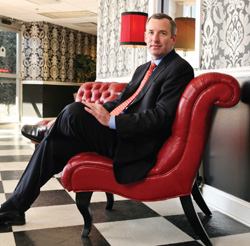
Mention the word “fund” to Laramar employees, and their eyes immediately light up. Woodward is no exception. His passion is undeniable as he talks about his latest, and perhaps greatest, fix: finding a way to efficiently raise capital that will fuel the company’s growth. Since Laramar was founded in 1989, the firm has sought capital for acquisitions from a steady group of investors on a deal-by-deal basis—typically a slow and inefficient financing method. Two years ago, just as the company started its major disposition program, the senior management team decided it was also the right time to raise its first capital fund.
Woodward, along with president Jeff Elowe and executive vice president Keith Harris, hit the road. The trio met with institutional investors in the United States and abroad with the goal of raising $250 million. The team exceeded its goal, raising $350 million with the help of its placement agent Credit Suisse. “Raising a fund is very difficult; if it was easy, everybody would be doing it,” Elowe says. “We were on the road every week for about a year.” The long days away from home paid off. The fund, when leveraged, has the buying power of $1.4 billion.
Laramar, now in full growth mode, has already invested approximately $100 million of the fund’s equity with the purchase of eight apartment communities across the country, from Los Angeles to Washington, D.C. “I think the new Laramar fund is an excellent vehicle for the company to expand its relationships with significant institutional investors, which should put the company on a path for continued expansion in the years to come,” says Scot Sellers, chairman and CEO of Archstone-Smith, who worked with Woodward in the 1990s.
Woodward expects the majority of deals in the fund to match the prototypical value-add Laramar deal. The firm targets 300- to 350-unit, 1980s buildings in C to C+ condition located in B+ to A, supply-constrained markets. Laramar renovates the properties and elevates them to Class B communities, with an average hold period of four to five years. “It’s the dog on the block,” Woodward says. “It’s the deal that is run down because the owner didn’t put money into it or they managed it poorly. It’s always competitive to find deals but [recently] even more so because more and more people [got] into this space.”
Problem solved. The new capital-raising strategy gives Laramar a huge competitive edge, since they can buy and close a deal in about half the time as in the past. Now, the money is ready to go. “Speed of execution is important today as it’s a highly competitive environment,” says Jeffrey Allen, president of San Juan Capistrano, Calif.-based J.B. Allen Realty, who also worked with Woodward in the ’90s. “Laramar can spend its time focusing on the due diligence necessary to pull the trigger on any given acquisition.”
Once the company has invested the fund money, which it plans to do within the next two to three years, it will move on to its second fund. Laramar’s strategic plan is to raise a series of funds over the next two decades, Woodward explains. “At any point in time, we will have two, three, four funds in the various stages of their life cycle, ramping up, ramping down, and overlapping,” he says, swiftly and confidently sketching the company’s 20-year future with a series of overlapping curves on scratch paper.
To the employees, the fund represents a future of financial stability. “The fund provides Laramar with financial security and also entices great people to come from bigger organizations,” says Mary Rogers, a regional manager at Laramar who recently joined the firm after several years spent working at Archstone and Equity Residential. “While we are private and small and don’t want to be one of the Equitys of the world, the fund is growth for us; it’s stability.”
OUTSIDE INFLUENCES Woodward certainly has a knack for seeing the big picture, but he also remains focused on constantly improving the company’s day-to-day operations. “That’s one of the reasons I came to work for him,” says Klaess, who previously worked for Archstone. “He is always looking for new ways of doing things that are going to make it easier for us to run our business.”
Woodward often looks outside the apartment industry for fresh, innovative ideas and smart business practices that solve everyday challenges. For instance, the company is implementing a virtual “dashboard,” a concept Woodward spotted in a BusinessWeek article that will assist his mid- and senior-level management team. The Web-based tool is popular in manufacturing industries and displays all the important information an executive needs in one quick glance. Critical, real-time company data is displayed in easy-to-read graphics, much like the instrument panel in a car.
“I don’t know of any apartment company doing this yet,” Woodward says. That may change after this article, but the CEO isn’t concerned. He’s always willing to share his ideas and push the multifamily industry ahead. But he also knows that by the time other companies test and implement their programs, Laramar will be a step ahead, working on its next great idea.
Laramar borrows many of its initiatives from the retail sector, which offers a natural synergy with the customer-focused apartment business. To keep and attract first-class leasing agents, the company was one of the first in the industry to switch to a commission-based payment method typical in most sales industries. As is commonly the case, the impetus behind the idea began with a conversation between Woodward and an on-site associate. Sales associates (they’re no longer called leasing consultants) still receive an hourly wage, but they are now paid a much larger percentage of their total compensation in commissions. “We are creating a career in apartment sales that doesn’t exist in the apartment industry.”
Sometimes the ideas are as simple as implementing an 800 number to track resident complaints—another idea borrowed from a retail store. The process is easy and inexpensive: Residents call the number with complaints, and a receptionist at the corporate office retrieves and transcribes the messages. The information is then e-mailed to regional and community managers who have 24 hours to respond to the inquiries. The ever-involved Woodward goes one step further and reviews a hard copy of all the memos each week, jotting handwritten suggestions to the managers. One such note: “Did you tell the resident who plans to move about our relocation program?”
And who knows? It might be just that kind of attention that helps Woodward discover the next big problem to fix.
LEADERSHIP LESSONS: DAVE WOODWARD
- Age: 40
- First Job: Real estate analyst for a syndication firm in California in the ’80s.
- Favorite Quote: “Far and away, the best prize that life has to offer is the chance to work hard at work worth doing.” —Theodore Roosevelt
- Favorite Book:The Fountainhead by Ayn Rand
- Best Business Decision: Focus our company on a few key areas and do them exceptionally well.
- Greatest Challenge: Continuously making everyone aware of the long-term vision while making sure short- and medium-term goals are being achieved.
- Best Advice Someone Gave You: You can learn how an entire organization operates from any position within the organization by observing every detail and asking a lot of questions.
- Person You Most Admire: Benjamin Franklin
- Hobbies: Triathlon, snowboarding, history, classic cars
HIGH HONORS
As MULTIFAMILY EXECUTIVE’s 2007 Executive of the Year, Dave Woodward joins an inspiring crowd. Past winners include:
- 2006: Ron Ratner, Forest City Residential
- 2005: Tom Bozzuto, The Bozzuto Group
- 2004: Steven LeBlanc, Summit Properties
- 2003: George S. Quay, Village Green Cos.
- 2002: H. Eric Bolton, Mid-America Apartment Communities
Living It Up
Dave Woodward shows his staff a good time. If you ever walk past Dave Woodward’s office be careful as you just might get hit with a Nerf ball launched from the CEO’s extensive Nerf gun collection. Laramar Communities’ Woodward undoubtedly works hard, but he also knows how to kick back and enjoy life.
“He has a wonderful sense of humor,” says Mary Rogers, a regional manager for Laramar, who recalls a classic Dave moment when he playfully tossed lemons at a colleague.
Woodward’s playful antics are a big hit with his employees, who also view their boss as a friend. He says hi to everyone he passes as he walks down the hall and frequently pops in and out of offices for a friendly chat. “When Dave is here, the whole attitude of the place lifts because he always stops in and sees everyone,” says Scott McMillan, Laramar’s controller.
And truly, there’s never a dull moment at the Greenwood Village, Colo., headquarters. On the last Friday of each month, the staff participates in a hole-in-one golf competition (right in the hallway) to win a bonus vacation day. And in the fall, employees try their hand at the annual Thanksgiving turkey bowl, where they get two chances to heave a frozen turkey down the hallway and knock over a giant pyramid of holiday-themed canned food. On rainy days, employees just might be lucky enough to get a special e-mail from Woodward with a pop quiz on Laramar trivia. The winners claim their prizes—typically Laramar logo products—in the CEO’s office. Watch out for flying Nerf balls.