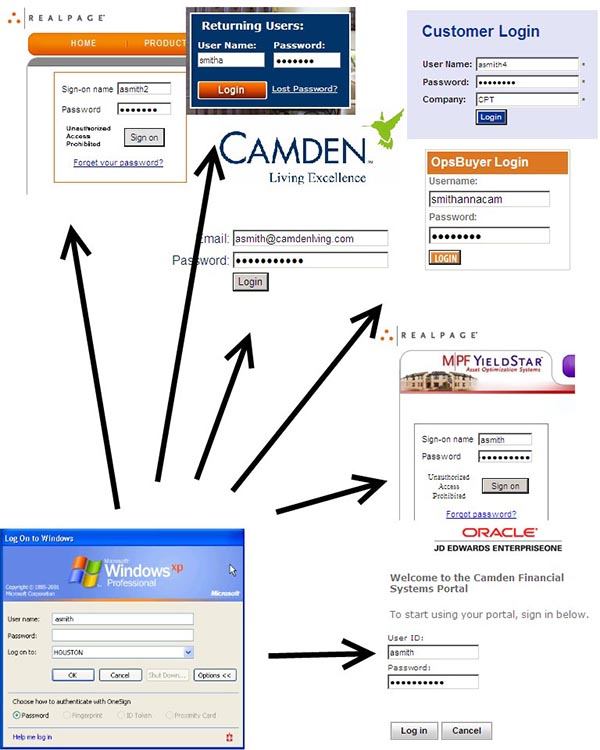
At Camden Property Trust, a Houston-based REIT, the password process had gotten out of hand. It was so bad, in fact, that associates did skits at company events mocking how many passwords they needed to remember just to log in to their network.Community managers had up to 14 passwords (some that expired as frequently as every 35 days) to manage on a daily basis. Not surprisingly, the company’s IT department would get a large number of user requests for assistance and improvements. Those who weren’t swamping the IT desk were often lining their computer screens with reminders.
“It was not uncommon to walk up to people’s desks and see sticky notes for [a dozen] passwords,” says Camden senior vice president of strategic services Kristy Simonette.
FAST FACTS
COMPANY: Camden Property Trust
PROJECT COST: $170,500 (includes software, hardware, external and internal labor, and travel)
NUMBER OF USERS: 1,750
SCOPE: Appliance-based client/server application designed to ease and secure password management
Ultimately, that defeats the idea of Internet security. So Camden turned to Imprivata, a Lexington, Mass.–based company founded by entrepreneurs who developed groundbreaking identity-management technology while working at Polaroid Corp.’s small-business incubator. Imprivata developed OneSign, a single–sign-on, appliance-based, client/server application that reduces the administrative overhead of password management. “Now, you can create one password and OneSign takes care of [the rest],” Simonette says.
As a bonus, the Camden system allows a new user to log on while preserving an old user’s session. This can be especially helpful in a busy leasing office where one leasing agent may be working on a computer and suddenly have to leave to take a client on a tour, only to have another user sign on to the same computer, erasing the first leasing agent’s session. “That was one problem that we weren’t even looking at solving,” Simonette says.