
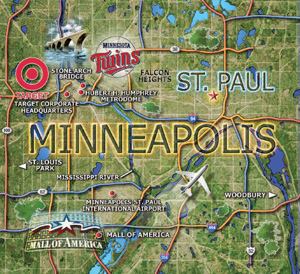
FUTURE PROSPECTS Camerata Apartments (220 units in St. Louis Park) is being developed by a team led by Mike Pagh of Great Lakes Management. Designed by Urban Works, a local architecture firm, the project is expected to break ground this year with occupancy scheduled for 2008. Camerata will be co-located with condominiums and commercial space. The apartments are adjacent to a proposed future commuter rail line that will provide access to downtown Minneapolis for workers from southwest suburban locations. St. Louis Park’s location, with convenient access to the central city lakes district and to several nearby major employment districts, has made it a popular location for new multifamily housing.
As rental rates strengthen and vacancies decline, the Twin Cities has generated more interest among property owners in rehabbing properties to achieve higher rents, especially in supply-constrained submarkets with higher barriers to entry.
A slowdown in the for-sale market has strengthened the rental market as some buyers have been pushed out of homeownership. Local developers generally agree that while the market is recovering, most submarkets in the Twin Cities have not yet hit rent levels that will justify new construction.
Despite the generally soft rental market in the Twin Cities over the past three years, new construction that came online during this period leased up well overall, better than originally projected. This occurred despite developments that were typically between 160 and 300 units in size.
ATTRACTIVE PROFILE
Demographically and economically, the Twin Cities remains strong with continued moderate population and household growth, an average age of 35.8 years, and a per capita income of $42,083. The Twin Cities ranks No. 1 of 25 major metropolitan areas in labor force participation and No. 4 in terms of people with bachelor’s degrees. It also ranks No. 1 of 25 major metro areas in terms of the number of middle-income households, No. 6 in terms of new job growth (34,100 jobs in 2006), and No. 1 in terms of homeownership (74 percent).
The area needs to be able to sustain its current level of job growth and attract more rental development to increase the supply of units available for investors. For sellers, buyers are willing to pay top dollar for good-quality rental developments. There are just not enough properties for sale.
Recent multifamily sales in the Twin Cities have traded at between $125,000 and $150,000 per unit for Class A and from the mid-$80,000s to roughly $110,000 for Class B.
“The capital glut and profit-taking 1031 buyers still drive demand and sustain aggressive pricing despite the institutional malaise shown for the Upper Midwest,” according to James McCaffrey, principal and senior vice president with Colliers Turley Martin Tucker in Minneapolis.
Without a doubt, he says, there’s room for improvement—and more development. “Why is it that interest rates, although still at historic lows, have spurred virtually no new construction in a major [metropolitan area] of 3.1 million people?” he asks. “Clearly, our rental economics are not keeping pace with other parts of the country.”
Mary Bujold is president and director of research at Maxfield Research, a real estate research and consulting firm in Minneapolis.
FAST FACTS
Considering Minneapolis? Here’s what you need to know:
- Population: 3 million
- Occupancy: 95.6%
- Median Age: 36years
- Median Household Income: $42,083
- Average Rent: $876
Unemployment: 3.7% NOTABLE: Twin Cities is home to 18 Fortune 500 companies in 2006. Cargill, headquartered in the Twin Cities, is the nation’s second largest privately held company. The New York Times has said that outside of New York, the Twin Cities has the finest cultural scene in America.
SOURCES: American Community Survey; Metropolitan Council; GVA; Maxfield Research