
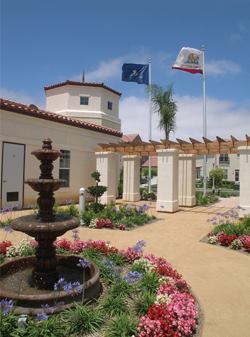
COMMUNITY BUILDING Developers have not disappointed. At a Jan. 16 topping-out celebration for Clark Realty’s 941-unit Pacific Beacon, a bachelors-enlisted quarters in San Diego, Jerry Dunaway, project executive of Naval Facilities Engineering Command Southwest, lauded the community, saying, “Our hard-working sailors will soon enjoy a lifestyle community like no other in the history of the United States Navy.” Set for completion in 2010, Pacific Beacon features rooftop pools, sky terraces, coffee shops, fitness centers, and expansive in-unit views of the San Diego Harbor.
“Beacon was conceived and built like a resort hotel or luxury multifamily property,” says Clark development executive Brian Lamb. “Our goal was to make this one as good as any mixed-use, urban multifamily asset in the country by over-delivering on amenities, services, unit sizes, furniture—pretty much everything needed to complement the traditional transient lifestyle of service members.”
Clark’s efforts mirror those of other established PPV players. Actus, for one, is incorporating Starbucks locations into many of its projects. Meanwhile, Forest City is taking its large-scale, walkable community expertise, which it honed in mega-projects such as the Stapleton Airport build-out, to create military communities that emphasize the ease of moving in and making friends. “At the start of this, the military wasn’t too sure what New Urbanism and walkable communities even were,” Moore says. “But they have embraced it wholeheartedly. Military people are relocating every two to three years, and they have to make a new community wherever [they are]. Having houses that are close together, no curb cuts, [and] centralized parks makes it much easier to make friends and a new ‘family’ when you move.”
Parker, for one, knows all too well the effect that the overall quality of military housing can have on service members, especially those that are deployed into combat zones. “The privatization initiative creates a comfort zone for soldiers overseas—they don’t have to worry about their families [living] in substandard housing; they’re not worrying that their loved ones are isolated and alone. It’s a win/win to create communities in partnership with the military that offer a greater quality of life, and, in turn, a higher sense of worth and improved morale. They deserve nothing less.”
The MHPI has also afforded the opportunity to incorporate cutting-edge green building features into military housing stock. Particularly in resource-conscious Hawaii, which has more than 15,000 units of military housing in various stages of redevelopment, sustainability is taking center stage. Forest City has used passive construction to complement air conditioning by aligning unit openings with prevailing breezes, and is incorporating tankless water heaters and wireless sub-metering to help push the efficiency of its units 43 percent beyond the Aloha state’s energy codes. And across the island of Oahu, Actus is installing solar-powered hot water heaters in 5,388 units and is further implementing laminated rooftop photovoltaic solar panels to create what the company claims is the largest solar-powered community in the world.
Developers participating in the MHPI are also paying closer attention to unit design and finishes, trying to offer what Lamb calls a “turnkey” lifestyle to service members who are regularly shipping out to new ports of call. In January 2008, for instance, Clark launched an “Above and Beyond” program with its suppliers. The goal was to get upgraded materials—the firm has even reached out to firms via the Chamber of Commerce to outfit units with such wares as better carpeting, televisions, computers, linens, and towels.
FORWARD MARCH Multifamily players that missed the MHPI ship can still cash in by marketing units to personnel living off-base or by preparing for upcoming rounds of federal real estate privatization. When it comes to the armed services per se, heavily militarized communities such as Watertown, N.Y. (home of Ft. Drum) have an overflow of service members who are waitlisted or otherwise can’t land on-base housing and use their basic housing allowance to shop apartments on the open market.
“We have 1,000 units across the Watertown area and we’re marketing aggressively to soldiers because they are such a big part of the community,” says Corey Aldrich, director of marketing for the United Group. The Troy, N.Y.-based firm is seeing increased competition as the military phases out its 801/802 housing policies that essentially leased up entire properties for service members in favor of the basic housing allowance program. “I’m doing everything from radio to target mailings to banner signage to aggressive Internet listings to working with the base to try and place soldiers,” Aldrich says. “The on-base housing is quality product; it is very competitive.”
Given the success of the MHPI, most expect the DoD—as well as a host of other federal, state, and municipal agencies and governments—to continue to lean toward privatization initiatives. The Army has begun an $1 billion initiative to redevelop all of its hotels and transient lodging, and the DoD itself has partnered with the University of Maryland to begin a master’s degree program in federal real estate privatization. [See “Basic Training,” at left.] “I know here in Southern California, the ranking Navy admiral has said that the aperture of privatization is still too narrow,” Lamb reports. “Most state and county development projects prefer those with privatization experience.”
Actus’ Parker agrees: “PPV is undoubtedly going to be the wave of the future.” And there’s certainly nothing dull and drab about that.
