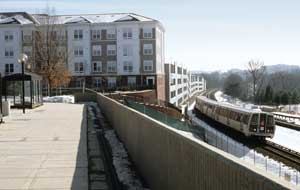
Starting from Scratch For most developers, transit-oriented building simply means putting multifamily, retail, office, and parking around mass transportation. But for Wareham development, a commercial, residential, and office developer and manager in San Rafael, Calif., transit-based meant something more. It meant building the train stop. Wareham owned about 10 acres on the Amtrak rail in Emeryville, Calif., when it approached the city about the possibility of building a station on its land. After watching its industrial base slowly disappear in the 1970s, the city was eager for anything that could jump-start its morbid economy. It not only signed off on the idea but provided the financing for parking at the station. Wareham did the rest by building the station, which it owns, in 1994 and eventually a community with office, retail, and condominium space.
Now, 10 years after Wareham completed the Emeryville station, it is the second-biggest train stop in California, with about 90,000 commuters transferring there per month. Most of them move between San Jose and Sacramento on the Capital Corridor line and stop at Emeryville to take another train into San Francisco.
The company built a 101-unit condo development and finished selling it in November. Company officials think the transit nature of the area contributed to heavy interest among empty nesters and young professionals in its condos. “People want the benefits of an urban lifestyle and the convenience,” says Geoff Sears, a partner in Wareham. “Many of the condo residents leave their cars parked during the day and take the rail into work.”
The condos went over so well that Wareham may build more multifamily units. Sears is astounded by how the 10 acres of land evolved. “We have built 900,000 square feet of office, condo, and retail space focused around the station,” he says. “This used to just be a station surrounded by a lot of empty land.”