
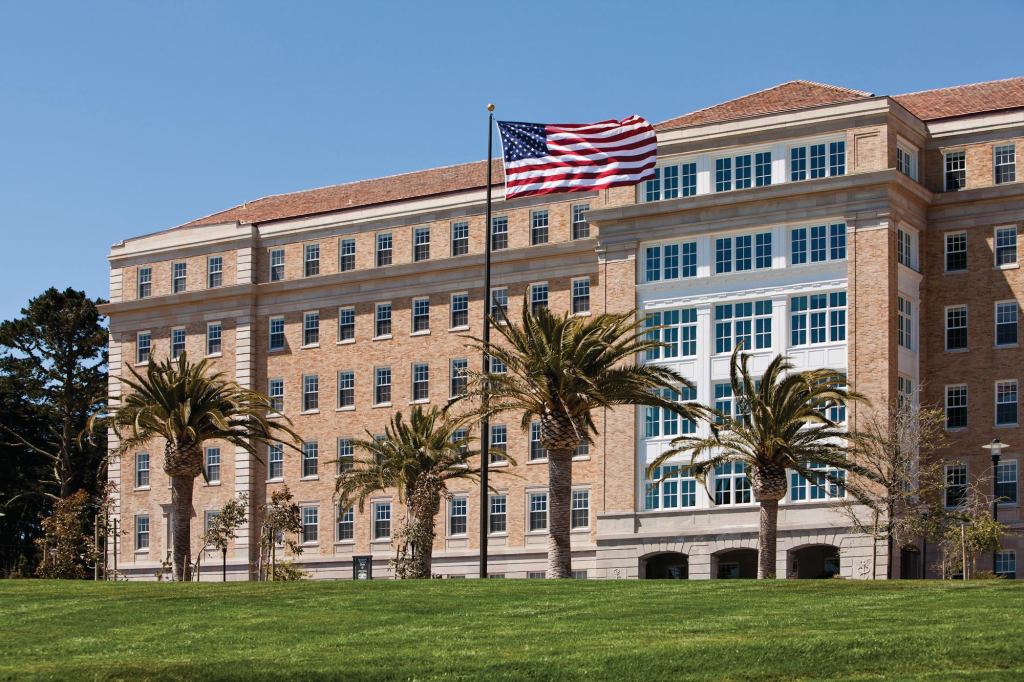
What’s more, original stick construction was replaced when the building was rebuilt from the U.S. Marine Hospital into the U.S. Public Health Service Hospital in 1932, and two wings added in the 1950s subscribed more to Brutalism than mid-century aesthetics. By 1981, however, the architecture of the building became irrelevant when the hospital was shuttered due to Reagan-era budget cuts. Abandoned until 1997, the site suffered dilapidation, vagrancy, and all of the wonderful things that accompany a squatter’s mentality.
“Even during our walk-through in preparation to bid on the RFQ in 2003, there was graffiti everywhere and needles on the floor,” Ratner recalls.
Learning Curve
1. Know the Site. Development policies in Presidio San Francisco National Park prohibit construction of new net square footage. Demolition of eyesore building wings allowed for the addition of three stories on the rear of the building and the construction of adjacent ultra-luxury, ultra-green townhomes.
2. Design Creative Spaces. Enlisting the help of longtime design partner TCA Architects, ForestCity made the best of an interior envelope originally designed for health care and military personnel rehabilitation, twisting individual rooms into 40 different urban-chic floor plans.
3. Patience Is a Virtue. Adaptive reuse that leverages historic tax credits is never an easy process. Throw in oversight by the National Park Service, the Presidio Trust, and an environmentally and sprawl-conscious neighborhood and resident base, and development and construction decisions can become myopic. Experience and an embrace of stakeholder concerns paved the way for ForestCity’s seven-year redevelopment time line.
— ForestCity notes three factors in Presidio Landmark’s success.
Negotiations with the Inner Richmond neighborhood ultimately resulted in demolition of the two Ike-era wings, which challenged ForestCity’s underwriting with a significant reduction in unit count but provided the opportunity to develop new units (including seven three-story, LEED Platinum–certified townhomes) in accordance with the Presidio’s policy on net-square-footage gain. In the main building, old hospital rooms and labs were reconfigured into junior one-, one-, and two-bedroom apartments. The resulting idiosyncratic floor plans—40 different ones across the property—have descriptive names like “the banjo” and “the tree house” that reflect design and location in the building.
“The unit designs we were able to accomplish are great,” says Ratner, who adds that Los Angeles/Irvine, Calif.–based TCA Architects were an invaluable partner in maximizing both unit count and design aesthetics. “In historic properties, you are stuck with your building envelope and typically cannot design the most efficient units. Some are big; some are small. If this were a new building, there would probably be only four plans, but the results are great, and the finishes are extremely well chosen.”
