
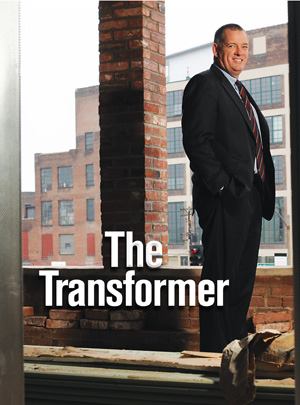
“The first time Kevin approached us, we all said, ‘Who are these people? Are they nuts?’” recalls Kathryn Bader, chairman and CEO of St. Louis-based U.S. Bancorp Community Development Corp., who at the time worked at U.S. Bancorp’s predecessor, Mark Twain Bank. “Nobody had put any money into this market in ages. What did these guys know that the rest of us didn’t?”
McGowan, of course, was relentless. “I can’t tell you how many times we turned down the deal, and they just kept coming back with new ways and new structures—and Krispy Kreme donuts,” Bader says with a laugh. About six months later, the bank decided to give McGowan and his brothers a shot and financed the deal using both state and historic tax credits—a tool McGowan continues to use to make his projects financially feasible.
The bank’s gamble paid off —big time. McGowan Lofts opened in 2000 , and the building jump-started development all along Washington Avenue. Before long, McGowan Brothers Development included five brothers. “They had a lot of incentive to join the company,” McGowan says: “a free loft and equal share in the company.” They built three buildings from 2001 to 2006, typically developing apartments above first- and second-floor commercial and retail space. As the McGowans purchased buildings left and right, the city and federal government committed $17.5 million for street improvements such as new street lights, brick pavers, and landscaping. Further spurring development, one of the major hotels on Washington Avenue announced a multimillion-dollar facelift. These initiatives helped the street “go from the apocalypse to what it is now—the most exciting street in all of St. Louis,” McGowan says.
TO INFINITY AND BEYOND
By 2004, McGowan was ready to expand his company beyond the borders of St. Louis. His brothers, however, didn’t share the same goals, so McGowan teamed up with three new partners, including former U.S. Title president Matt Walsh, to form McGowan Walsh. (McGowan is still an owner in McGowan Brothers Development.) Never one to follow tradition, McGowan didn’t hire employees boasting long resumes chock-full of real estate experience. Instead, he recruited people he had met over the years with specific skill sets, such as Dan Langley, whose 20 years of problem solving for IBM help him in his current role as chief operating officer and partner at Blue Urban.From October 2004 to October 2007, the nearly 20-person McGowan Walsh firm had under development or completed approximately 2.2 million square feet of projects in St. Louis and Kansas City, Mo. McGowan credits much of the success to buying at the right time; he purchased a number of his buildings at very low prices back in the late ’90s. “Let’s just say I am in $20 a square foot less [than other developers],” he explains. “I can sell for $180,000 where someone else can sell for $200,000. flat is what has afforded me the ability to expand.”
By 2007, McGowan was itching to explore deals beyond Missouri. Walsh, however, didn’t share the vision, so this past October, the ambitious McGowan started Blue Urban—his third multifamily development firm in less than 10 years. The company, which includes most of the McGowan Walsh employees, is completing all of the development projects started under the McGowan Walsh moniker while diving headfirst into new opportunities. Blue Urban currently has more than 2 million square feet of development in the works throughout Missouri and Ohio, representing $400 million in assets.
Not surprisingly, all of the employees have a passion for urban revitalization and the majority live downtown. “Working here is something bigger than your 9-to-5 job,” says Gregory Trost, Blue Urban’s director of design. “There is a huge buzz about the work we do and our presence.”
BRAVE NEW WORLD McGowan is always on the prowl for the next great building—ideally sized 100,000 square feet or larger. “It’s a disease,” he says. “I can’t drive down a street without looking at all of the buildings and seeing if there is an opportunity. It’s been that way my whole life.”
True to its word, Blue Urban has expanded beyond Missouri to Cleveland and Cincinnati, Ohio, and it recently entered uncharted territory more than 200 miles away from St. Louis in Springfield, Mo. In June, the firm will break ground on one of its most challenging historic rehabs to date—the $25 million renovation of the roughly 155,000-square-foot Heer’s Department Store, which sat vacant for nearly 20 years on the town square in downtown Springfield. When completed in 2009, the mixed-use project will include 41 condo loft units; office space; a hip bowling alley; and a Mike Shannon’s Steak and Seafood Restaurant—a Missouri chain owned and operated by McGowan’s family and named after his father-in-law Mike Shannon, a beloved Cardinals baseball announcer.
Emblematic of Blue Urban’s development philosophy, the company agreed to redevelop the building only if the city committed to renovating the town square. “To capitalize on the subsidies and credits and walk away with a couple-million-dollar developer fee is one thing,” McGowan says, as he glances at sketches of the redevelopment plans hanging on his office wall, right next to his children’s artwork. “But that is not the Blue Urban thing, so to speak. We are now going to make a difference in Springfield in a huge way.”