
“We found there is a big difference between change of state and change of countries,” says Espais General Manager Andres Hogg of learning about strict New York City building codes. In fact, Espais had to hire New Yorkers to help them understand local laws. “Get local people to manage it,” he says.
The other lesson was in money. “People should really double-check their numbers,” Hogg explains. “Financing is changing on a daily basis, and the rules of the game are very monetary right now.” Hogg says Espais had to be diligent about keeping on top of the financial situation to avoid overspending and cutting into profits.
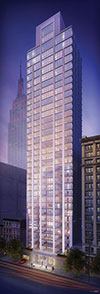
Both pieces of advice helped Espais deliver a $165 million, glass-infused building that is 50 percent sold before its opening this summer. Hogg said buyers ranged from European investors to young, local families.
Designed by H. Thomas O’Hara Architects, the project includes 142 residences ranging from 536 square feet to 1,309 square feet. The units are priced from $600,000 to $4.5 million.
Principal Architect Fariba Makooi said Espais wanted a modern look that took advantage of the views of the Empire State and Chrysler buildings. But she also didn’t want Twenty9th Park Madison to blend into the neighborhood design. “A lot of the buildings around there are pretty old,” Makooi says. “We wanted to stand out and be very modern.”
That contemporary feel continues on the interior with sleek design elements and high-end amenities such as wenge wood cabinetry and crystal white countertops. The project’s outdoor amenities include a spacious roof deck with two kitchens, several barbeque grills, and a sunbathing deck.
BITES:
Brooklyn, N.Y.: There are a lot of options for buyers considering The Rialto, a four-story, 31-unit condominium building developed by 150 North 5th Street. Every apartment layout is different, so prospective owners will have an unmatched degree of control over the design, according to developers. Architect Gene Kaufman and interior designer Andres Escobar transformed a former furniture factory into loft-style residences ranging from 821 square feet to 1,843 square feet. The building features large glass windows and 20-foot ceilings. Prices start in the high $600,000s.
Lemont, Ill.: Developer Marquette Cos. finished the first phase of its $250 million mixed-use Lemont Downtown Redevelopment project in May. Residents are already moving into The Front Street Lofts, which includes 82 lofts, 24,000 square feet of ground-floor retail space, and a 262-car parking structure. Units range from the low $200,000s to high $400,000s. The project is intended to bring new energy and residents to a historic location along the I&M Canal. To honor the town’s character, Marquette Cos. used Lemont yellow limestone, which is indigenous to the region.
Oakland, Calif.: The city of Oakland just got its first LEED Silver-certified multifamily project. The Uptown is a transit-oriented apartment community in the city’s historic arts and entertainment district. The project contains sustainable elements such as designated VIP parking for hybrid or alternative-fuel vehicles and landscaping that uses 50 percent less water. The Uptown’s first phase is complete and open for leasing. It is being built by a subsidiary of Forest City Residential Group, through a joint venture with MacFarlane Partners and the City of Oakland Redevelopment Agency.
Brawley, Calif.: AMCAL Multi-Housing, an affordable and low-income housing builder in California, recently opened the 72-unit Valle del Sol, its first property in Imperial County. The 100 percent affordable housing project features units ranging from 631 square feet to 1,046 square feet, along with a clubhouse, open space, and a swimming pool. The $11.2 million project was financed with more than $8.8 million in low-income housing tax credits and another $16.3 million from Hudson Housing Capital, California Bank & Trust, and the nonprofit Foundation for Affordable Housing. Valle del Sol will have units for residents that earn between 30 percent and 60 percent of the area median income. Rents will range from $285 to $780 per month.
New York City: A new housing project called 40 East 66th Street is one of the last Rosario Candela buildings to be converted to condominiums. The building, originally constructed in 1929, has been transformed by developer Vornado with details such as a polished lobby, vaulted ceilings, and patterned, marble floors. Occupancy is expected for December 2008.
Santa Barbara, Calif.: DBN Development has earned final approvals on Radio Square, its mixed-use development in downtown Santa Barbara. Plans call for razing an old strip center to clean up an environmentally impacted site. The project will ultimately combine 32 residences, more than 16,000 square feet of commercial space, and residential parking. Five of the units will be sold as affordable. The environmental cleanup will begin in late 2008, and the project’s construction will likely be completed in late 2010.
Queens, N.Y.: The Community Preservation Corp., a nonprofit affordable housing lender, has provided a $2.26 million loan for the construction of seven two- and three-family homes in the Far Rockaway neighborhood of Queens. The six two-family homes and one three-family home will contain extra rental units and offer eligible families subsidies of between $32,000 and $40,000. The asking prices fall in the $400,000s and will be affordable for families with average annual household incomes ranges from $53,000 to $73,000. Owners will offset their mortgage payments with revenue generated from the rental units.
Denver: Commercial real estate company Behringer Harvard has added luxury residential housing to its portfolio by investing in Alexan Prospect. The 400-unit multifamily community is slated for construction in the Central Platte Valley, a 120-acre area immediately west of downtown Denver. Trammell Crow Residential is developing the project, which includes 367,433 square feet of rentable space. The allure for the project was its location, which is near major roadways, public transportation, and downtown amenities such as Coors Field, the 76-acre ballpark that’s home to the Colorado Rockies baseball team. The up-and-coming area once consisted of rail yards and warehouses but is now a mixed-use neighborhood with housing, parks, and commercial opportunities.