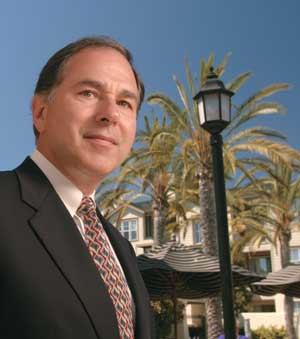
Institutional Control The challenge in generating these robust returns is that SSR must take a more conservative approach than many private developers because it’s buying for institutional investors that don’t want to see billions of retirement dollars directed to risky investments. “We will never be as aggressive as a private entrepreneur, and that’s not our mission,” Allen says. “Our mission is to be stewards of our investors’ capital. We are managing other people’s money … we have to be cautious with that.”
But, that doesn’t mean there is not a place for rehabs or even development, which traditionally have more risk than buying an established multifamily property, in SSR’s portfolio. The company offers various funds for each investor’s taste. For instance, the CalSTRS’ account calls for SSR to take a conservative investment strategy. The pension fund would like a 10 percent internal rate of return on a low risk, core investment.
However, other funds, allow SSR to take bigger risks. “Every one of our funds has investment parameters, and we need to be consistent with those,” Allen says. “If we were given a pot of money to spend on high-risk ventures, we would have the capacity to do that. But most of the funds we run are not high-risk pockets of money.”
Nowhere is the conservative nature of institutional investors more apparent than in development. Because development is riskier than buying class A properties and even doing rehabs, institutional investors will generally shy away from it. However, this is in direct contrast to Allen’s background. He readily admits that he is a developer at heart. He started out developing commercial buildings, eventually moving to entrepreneurial multifamily environments at Paragon Group and Security Capital Group, which later became Archstone Communities Trust. After he worked as an outside contractor helping SSR determine the viability of a high-rise development in San Francisco, the company’s former president and CEO, Thomas Lydon, brought Allen on board to head up SSR’s development arm.
Unfortunately, the economy turned shortly after Allen came on in March 2001, and the company’s investment criteria began to stand in the way of most development opportunities. To do a development, SSR wants a return of 200 basis points above what it would get on a core investment, which is mainly newer, stabilized class A properties. “If we were looking at core investments with a stabilized return on cost of 7.5 percent, then we would need 9.5 percent returns to do a development,” Allen says. “The 200 basis points were what we considered to be an appropriate risk adjustment to go from core investing to development.”
This doesn’t mean the Multi-Housing unit shies away from all development. It’s working on 315 units in San Jose, Calif., and, as of press time, it was about to finalize a deal to develop a high-rise in Washington. Both deals are with partners, something SSR expects to do more of in the future. “Through joint ventures with third-party developers, we can provide capital as well as development oversight, but we are not responsible for personnel and project management,” Allen says.
Portfolio Management The company follows no secret formula when it decides what properties it wants. While the desire of the institutional investor is paramount, SSR usually looks for properties in high-barrier-to-entry locations, such as those found in the Northeast corridor (Washington to Boston), California, Seattle, southeastern Florida, and Chicago. “In these markets, [the cost of] land is very, very high relative to commodity markets,” Allen says. “There also are barriers in getting entitlements.”
Though SSR usually shies away from commodity markets, such as Phoenix, Dallas, and Atlanta, their potential job growth makes them attractive at certain points in the economic cycle. “At the appropriate time, we will deploy capital in a commodity market,” Allen says. “We find them interesting because of the job growth these markets can develop over time. But you have to be cognizant of the supply pipeline. If supply gets ahead of demand and you are not careful, you can get crushed.”
Though many multifamily firms seek markets with high-barriers-to-entry, not all companies follow SSR’s strategy, according to Jay Jacobson, director of multifamily investments for Archon Residential, a competitor of SSR’s based in Las Colinas, Texas. “I think they are making bets on some markets that other people may not see positives in,” he says. “They are looking at continued growth in markets that some others see slowing in, and they see some markets recovering faster.”
This feeling is not the same across the board, though. “I think they are looking at the right markets in terms of investment strategy,” says Brad Griggs, CIO of BRE Properties, another competitor of SSR’s based in San Francisco. “They don’t take a shotgun approach. We are drilled in like a laser beam in certain markets and so are they. Jeff is focused on his markets, and I think it makes him and the company very successful.”