
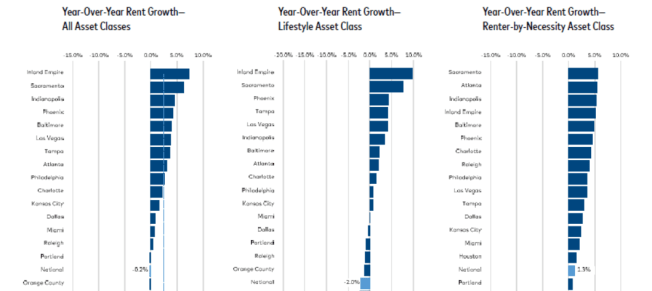
Multifamily rents fell by 0.2% on a year-over-year basis in January, according to Yardi Matrix’s latest Multifamily National Report, marking a 20-basis point increase from the YOY rent growth rate recorded in December. Overall, rents rose by $3 to $1,392.
California’s Inland Empire leads the top 30 metro markets for YOY rent growth at 7.4%, followed by Sacramento, California, at 6.3% and Indanapolis at 4.5%. Of the top 30, 16 out of 30 are still experiencing YOY rent declines. Some are showing recent improvement; San Jose, California, is up 40 basis points to -13% YOY, and Washington, D.C., is up 40 basis points to -4.5% YOY. However, New York (-12.2%), San Francisco (-9.8%), and Boston (-3.8%) remain on a YOY decline.
Month-over-month rent growth is now positive in a majority of markets, with a 0.2% increase at the national level from December to January. This marks a 40-basis point increase from December. San Jose led the top 30 markets on a month-over-month basis at 0.9%, following several months at or near the bottom of the list. The worst-performing markets include New York at -0.6%, Denver at -0.5%, Nashville at -0.4%, and San Francisco at -0.4%. Yardi attributes declines in Denver and Nashville to an influx of new apartment stock.
Conditions at the beginning of 2021 would appear to signal a “light at the end of the tunnel,” Yardi says, including rising vaccinations, declining unemployment claims, steady consumer spending, and loosening restrictions in some areas. If this holds steady, rents could begin to rise in the coming months in many markets.
It is as yet uncertain how pandemic-era out-migration will affect rent growth in gateway markets. According to the report, industry sources say that only about half of moves out of gateway markets during this period are permanent.
In April 2020, Yardi Matrix released a report detailing the top 10 markets at the greatest risk for rent declines, with employment losses among the factors in its predictions. This list included Las Vegas; Florida’s Southwest Coast, Orlando, Fort Lauderdale; and Houston, all of which were found to have 35% or more of its employment base in “at-risk” sectors.
However, many of these markets have seen strong rent growth throughout the pandemic—led by Las Vegas at 3.8% YOY. At the same time, rent growth in many of the markets with the lowest percentage of jobs in at-risk sectors, including New York and Northern New Jersey, has suffered over the same period.
Overall, Yardi does not see a direct correlation between rent movement and occupancy. Stronger correlations have been found in migration trends or rent costs; areas with the highest costs of living have lost the most residents.