

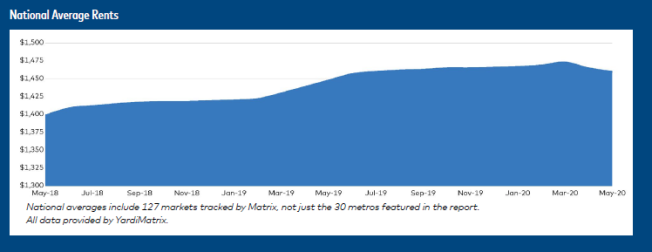
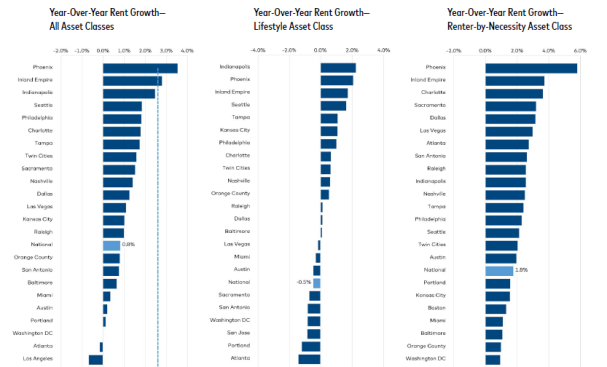
The national average rent fell by $5 to $1,460 May, marking a $13 total decline from March, according to Yardi Matrix’s latest National Multifamily Report. Overall, rents rose by 0.8% on a year-over year basis, compared with 3.5% YOY rent growth in May 2019.
Gateway markets have shown the sharpest declines in rent YOY. Boston and San Francisco are tied for the steepest rent declines at -1%, followed by Chicago at -0.9% and Los Angeles at -0.7%. Phoenix, on the other hand, has shown the strongest major market rent growth at approximately 3.5% YOY.
In the short term, rents fell by 0.3% on a month-over-month basis—slightly better than the 0.5% decline observed in April. Only three markets retained positive rent growth for May—Kansas City (0.4%), San Antonio, and Baltimore (both 0.1%). Houston and San Jose had the most dramatic MOM declines at -0.9%, followed by Nashville, Orange County, and Seattle at -0.8%.
While the United States has begun to reopen some nonessential businesses, the shape and timing of a potential recovery is “heavily debated.” According to Yardi, a quick recovery is unlikely at this point, “absent a rapidly deployed pharmaceutical solution.” Yardi expects rent declines to continue through the summer, with a potential resurgence in the fall as the unemployed return to work.
May rent collections held strong, with 93.3% of households paying all or a portion of their rent by May 27, according to the National Multifamily Housing Council. However, rents are declining across the board, particularly in the Lifestyle asset class.
New unemployment claims have declined from their crisis high in March, but initial jobless claims total over 40 million since March 23, or approximately one-quarter of the workforce. The extra $600 in unemployment benefits provided by the CARES Act is expected to expire at the end of July, leaving some question as to whether a decline in rent collections could follow. The HEROES Act, passed by the House on May 15, proposes expanding these benefits through January 2021, among other considerations. Yardi expects the package to run into “significant opposition” in the Senate.
In a study of the top 50 metros by total employment, Yardi has ranked each metro by the strength of their “durable employment sectors,” including jobs in government, finance, and professional and technical services. The markets with the highest concentration of these job types are Lansing, Mich., at 44%, Washington, D.C., at 41.8%, and Sacramento, Calif., at 34.5%. Yardi notes that month-over-month rents in Lansing bounced back by 0.6% in May, following a 0.5% decline in April.
Las Vegas sits at the bottom of the list at 19.8%, owing to its heavy reliance on tourism. Milwaukee follows at 20.5% and Memphis, Tenn., at 20.6%.