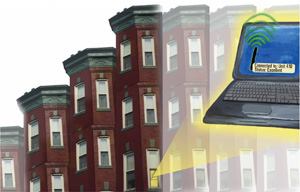
Multifamily operators can overcome those headaches by contracting with wireless service providers that manage residents’ access. Doing so allows owners to take themselves out of renters’ crosshairs, should they become frustrated by any technical difficulties that may arise. They also avoid any security issues related to residents running their own, unsecured networks. For example, some operators who provide WiFi to residents write provisions into the lease agreements prohibiting outside routers, according to Holtz. “Since they are already providing it, they can put into the lease addendum that they don’t allow rogue access points,” Holtz says.
THE BIGGER PICTURE Multifamily professionals believe that while technology will continue to advance, in-unit WiFi will not become obsolete. For instance, they’re not worried about the city-wide, municipal WiFi nets that have been making headlines lately. As is often the case with cell phone signals, tech experts say those networks will have trouble penetrating the core of your building. Speed, reliability and maintenance of those systems are also often cited as stumbling blocks.
“City-wide nets are trying hard to get off the ground, but we still haven’t seen any extraordinary success stories,” says Frank Matarazzo, president and founder of Hawthorne, N.J.-based MSTI Holdings, which deploys and runs wired and wireless networks for multifamily clients. “We painstakingly do onsite surveys to make sure that we have got penetration in even the smallest nook and cranny of the building.”
At Clifton, N. J.-based Value Companies, which owns and manages more than 3,500 residential units in New Jersey, New York, Pennsylvania, Texas and Florida, executives were able to partner with Verizon to get the firm’s high-speed FiOS fiber optic Internet service installed at three of its communities in northern New Jersey. The agreement resulted in a “material, revenue-producing event” at Value Companies, says Jonathan Moore, the company’s vice president of development. What’s more, it’s also given the firm a leg up on the amenity front when it comes to competition. That’s especially beneficial considering that most of its Northeast portfolio consists of properties built in the 1960s and 1970s. “Now, we are able to give our residents 21st century technology in a well located, well maintained building, even though our portfolio is older,” says Jack Linefsky, director of operations at Value Companies.
As part of the standard package, which covers phone, digital TV service and Internet access for around $100 a month, Verizon also installs a wireless router in each unit. In fact, that’s the standard way for residents to connect to the Internet, unless they request otherwise. “If you want a hard-wired CAT 5 connection, they will wire a specific jack for the computer in your apartment,” Linefsky says of the high-speed Ethernet. “But the basic installation comes with WiFi, so you can be active and online anywhere within your unit. That’s the option most people are choosing.”
With the rapid proliferation of WiFi everywhere else in residents’ lives, it’s not hard to understand why.
Joe Bousquin is a freelance writer in Auburn, Calif.
ACTION ITEMS CUTTING THE CORDS
- Anticipate the demand. If your residents aren’t clamoring for in-unit WiFi yet, they will soon. You better give it to them, or they’ll set it up themselves, making for big tech and security headaches.
- Analyze the numbers. With new equipment and lower costs, setting up a WiFi network at your community today becomes easier, and cheaper, every year.
- Contract with a service provider to get WiFi in your units. You can make money from these agreements, and residents won’t associate technical snags with you.