
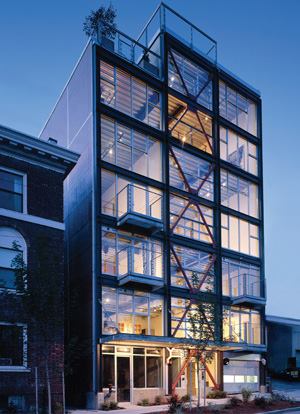
Glass, too, plays a major role in these designs. Large expanses of floor-to-ceiling windows are a distinct departure form the “punched openings” of more traditional buildings. “People who live in the city want open expanses of glass to more fully connect them with nature,” says Dunn, who begins all her projects by figuring out how to get the largest windows possible. Why? To deliver residents “a meaningful indoor-outdoor experience.”
SPANNING THE SPECTRUM Bob and Karen Ranquist’s story is remarkably similar to Dunn’s. The pair pursued a passion for contemporary design roughly 10 years ago, building a series of smaller, boutique-style condos that garnered loads of awards and national press.
“We started small and found there was a niche for it,” Karen says. “It wasn’t something that was offered at all. Clean lines and minimalism set us apart from the people who are, literally, building next door.”
Chicago-based Ranquist Development has proper ties scattered throughout Chicago that stand out sharply against a sea of red brick and limestone. Most incorporate the same elements as Dunn’s projects: floor-to-ceiling glass, high-end detailing such as exotic wood, and Arclinea kitchens. On the exterior, there’s flagstone and treated red cedar cladding, zinc panels and cement board. Outdoor space is maximized with roof decks and “green screens”—vertical trellises climbing with ivy. “We’re not just going to put up a little evergreen shrub and call it landscaping,” Karen says.
Dunn and the Ranquists both play in the shallow end of the developer pool with boutique projects. But today’s modernism can be successful on a larger scale. Chicago’s CMK Realty Corp. has put together a similar look for high-rises with upwards of 400 units.
CMK’s biggest success to date, 1720 S. Michigan in Chicago, was the top-selling condo in the downtown in 2006. “As with all our buildings, the contemporary modernist styling really sets us apart and gives buyers an alternative,” says Scott Hoskins, the company’s president and managing broker.
Their target is first- and second-time home buyers—the same young, style-conscious professionals driving the modernism resurgence. “We give them the chance to live in an amazing home in a great location at a reasonable price,” Hoskins adds. “When we first started this [in the mid-1990s], banks were hesitant to get involved … but time and time again, we’ve proved that there is a market for it.”
Indeed, the company has developed around 10 such sites in downtown Chicago and has another 714-unit building under construction. “Pretty much all we do is high-density, urban multifamily projects,” Hoskins says. “With larger projects, you’re netting more revenue because you have more units.”
Price points further enhance CMK’s success. “Entry point in the market is one of the most important factors to our buyers, so they’re willing to trade off a little square footage for a better price,” he says. One such cost-saving measure: Shave off about 1,000 square feet of interior space per unit to achieve a higher level of design. And with spaces including floor-to-ceiling windows and 10-foot ceilings, they feel bigger anyway.
Large or small, Hoskins says, “I don’t think there’s any question that modernism is here to stay. There’s always going to be those people who appreciate the artistic nature of the contemporary architect and what the architect creates. Even if it’s a small percentage … those buyers think of housing in terms of how it defines their personality and their taste.”