
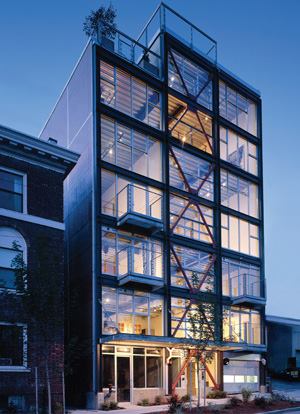
RIPPLE EFFECT It’s easy to imagine that modernism has a welcome reception in Los Angeles, but the region was thirsty for good design eight years ago when Lawrence Scarpa completed his first lofts project. The principal of Los Angeles-based architecture firm Pugh + Scarpa readily admits that lofts are nothing new—except that in the Southern California enclave, in 1999, they were. That development—the Bergamot Artists Lofts—opened the door to other contemporary multifamily work. Today, 70 percent of the firm’s business is market rate and comes from word of mouth.
Now Scarpa is single-handedly attempting to spawn the same kind of revitalization in downtown Charlotte, N.C., via a satellite office. “There is a major market now that didn’t exist five years ago,” he says. “Where there is nothing, there is a demand. Charlotte has a million people and you can’t tell me there aren’t 10 people out of a million who want this kind of project. There will be a market.”
He’d be one to know. With a background in subsidized housing, Scarpa was used to projects that deliberately flew under the radar, implementing them on a shoestring budget and turning a tidy profit. In a landscape of exorbitant prices (market rate is north of $700 per square foot in Southern California), his projects consistently sell for above market value. “Land prices are high, so you have to have a product people really like,” he says.
Now, Scarpa is starting a 12-unit, for-sale loft project in Los Angeles that will drive his point home: It uses no structural steel. “Once you understand the structure, you can free up some money for other things,” he says. “We go for substance over style.”
The one-time niche of modern design is not limited to isolated regions. It’s suddenly everywhere: in Washington, D.C., where Bethesda, Md.-based McInturff Architects won a 2007 AIA award for 1247 Wisconsin, a rooftop village of modern residences in historic Georgetown; in Philadelphia, where design-build firm Plumbob is causing a stir with its innovative, green-friendly “flats” projects in the blue-collar Fishtown neighborhood; and in conservative Boston, where Office Da’s dramatic 150- to 200-unit building is reinventing the downtown.
“We’re a more design-sensitive populace than we ever were before, and it’s all around us, this design culture,” says Will Bruder, president of Will Bruder + Partners, a Phoenix architecture firm that has done groundbreaking projects in Scottsdale, Ariz. “We all look for a hip place, a modern place … and top design is selling for top dollar. These projects are bringing in much bigger returns because you’re selling art.
“The future of multifamily is modernism, most definitely,” Bruder adds. He envisions the movement causing a ripple effect beyond the multifamily industry, and sees urban infill as a laboratory for building the next great American city. “We’re going to have new town squares, new neighborhood enclaves,” he says. “And it’s going to be much more livable. We could actually make America a place of cities and towns again.”
Jill Waldbieser is a freelance writer and design buff living outside Philadelphia.