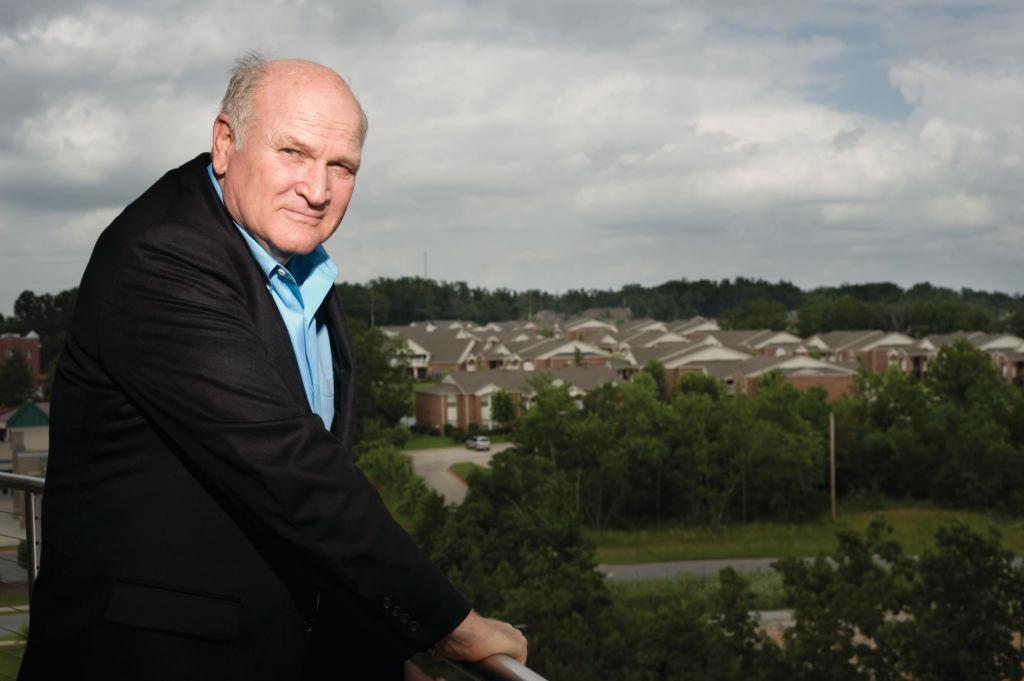
“For the average medium-income person who lives in an apartment, it means a lot to live near a golf course,” Lindsey says. “They don’t want to pay for it, but if they can get it as an extra, it will keep you 100 percent occupied when someone else is 80 percent occupied.”
The 18-hole courses have a different dynamic, though. They have their own clubhouse and amenity structure because Lindsey can sell memberships. “Ones that have memberships can hold their own,” Kevin says. “Ones that don’t have memberships will be hard to make work.”
That work, as it often does, lies in the financing. Basically, the debt and land for the smaller courses is on the apartment buildings, while the company has to make the course work under the apartment loan. But, if the company can use the course to keep occupancy in the high- 90 percentiles—and get an extra $25 to $50 per month—the math works.
“It adds a little more prestige to the apartment complex, and it allows them to charge a little more rent because of that prestige,” says Williams of Bank of the Ozarks.
And that niche allows Lindsey to offer something unusual. “He’s able to find markets that are underserved and apply his formulas to those particular markets with a quality product at a price you’d expect for a product with no amenities at all,” says First Security’s Taylor. “Some have aquatic parks. There is a lot of green space with picnic areas, volleyball fields, and basketball courts. It has a country club feel for not a country club price.”
5) Do What You Say You Will. And Lenders Will Follow, Even in Bad Times.
Lindsey Management has a lot going for it—5 percent of its assets are unencumbered, and a number more will be fully owned in the next four years. And it’s put 25 percent equity in all of its deals. So even in the deals that aren’t paid off, it’s in good shape. Furthermore, Lindsey really knows its stock because with the exception of two properties, the firm built every unit from top to bottom. Additionally, with the exception of two Dallas-area deals Lindsey did with old football buddy Jerry Jones, the company doesn’t sell assets.
But Lindsey hasn’t been immune from the past two years. In fact, while markets such as Oklahoma remain strong, it’s getting hit hard in its backyard around the Fayetteville area, where vacancies are at 85 percent this year. And like everyone, the company has seen its values fall from the construction loan to extension time. But Lindsey isn’t handing the keys back to the bank.
Lindsey Management Co.

Headquarters: Fayetteville, Ark.
Year Founded: 1985
No. of Employees: 1,000-plus
Units Owned/Managed: 33,293
No. of Units Built in 2009: 2,180
Occupancy: 93 percent
Market Coverage: Arkansas, Alabama, Kansas, Mississippi, Missouri, Nebraska, Oklahoma, Tennessee
“When asked to step up, they have stepped up,” says Harry Justice, a senior relationship manager in real estate banking with Minneapolis-based U.S. Bank, one of Lindsey’s lenders. “They haven’t shirked their responsibilities. Not all builders have the ability or willingness to step in and right-size things if it requires that. They are able to do that and have the willingness to do that.”
Lindsey wouldn’t have it any other way. “Jim is probably the premier name in this neck of the woods,” says Scott Provost, a vice president for Birmingham, Ala.-based Regions Bank Capital Markets, one of Lindsey’s lenders. “He’s been doing this for a long, long time and has always performed as expected. People know when they lend to Jim Lindsey, they get paid back.”
The problem the past few years wasn’t their local construction lenders (who have, so far, weathered the storm), though. It was the secondary market. Like most builders, Lindsey relies on a number of institutional lenders, such as J.P. Morgan, Massachusetts Mutual, and the New York Teacher’s Retirement System, to take out those construction loans on long-term deals. After things blew up in the fall of 2008, Lindsey says the permanent loan “backed up” for him, which didn’t make him alone.
But the company was still able to get some projects off the ground and, after a six- to nine-month lull in the secondary markets after the financial collapse in 2008, Lindsey has seen things open back up. In what might be a small indicator of its stabilized fundamentals, Lindsey says that as of the last day of April, it had 518 more units rented than at the end of April 2009. And that bodes well for the future. The firm expects to start 1,250 to 1,750 units per year in 2011 and 2012. That will only add to what Ryan says has become an impressive yet distinct company—“an institutional-sized company that’s operated kind of like a family-run business.”
“He’s got a whale of an empire there that’s come through the worst time in market history, and he’s survived with very little nicks himself,” Ryan says. “He’s got only big upside.”