The repeatable formula also works for the math fan in Lindsey. “My guess is that when he goes to build one, he’s less than 1 percent off what he thought the budget would be,” says Ryan of M&T Realty Capital. “He’s got that down pat.”
Even though Lindsey Management generally doesn’t go through the zoning process (he prefers land as close to finished as possible), the surrounding community will ask for changes. This has forced the company to upgrade architectural features and add more brick, change façades, or occasionally even add density. For instance, the city of Fayetteville asked the company to build up to four stories in its The Links at Fayetteville project. It was the first time Lindsey, which likes to stick to about 12 units an acre, has gone to four stories.
Lindsey’s efficiency extends to its building process. It handles everything from development and entitlement to architectural to construction. It charges its partnership less than the typical builder fee. “We give that back to the lender because we think it’s a basis to get good loans,” Lindsey says. “I feel like the banks have felt like they were getting as close to wholesale product as was possible to be delivered, and they trusted us with that.”
Lindsey Management usually chips in about 25 percent of the equity on its deals, providing even more cushion. “They don’t charge the partnership any ridiculous development, architectural, and general contractor fees,” HFF’s Carlton says. “He’s not charging himself. He’s paying his people but delivering a wholesale product.”
4) Give ’Em Something They Can’t Find Anywhere Else.
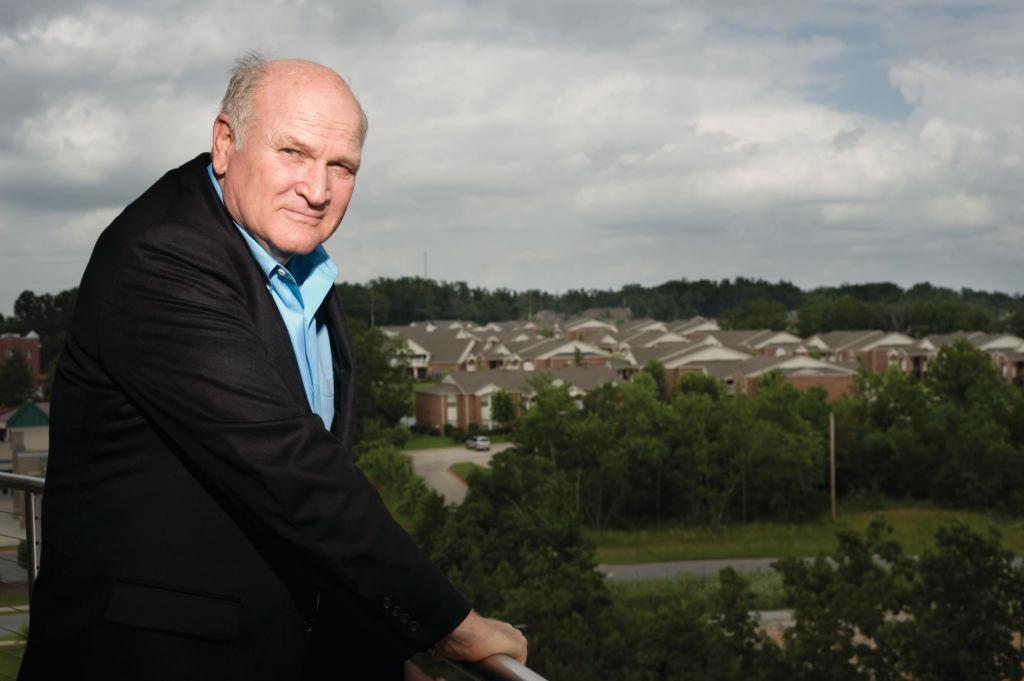
Jim Lindsey is the face of Lindsey Management. And as a former professional football player, local gridiron hero, and even one-time gubernatorial candidate in 1976 (at the time, he was rumored to be gunning for Blanche Lincoln’s Senate seat), he fits the bill perfectly. But dig a little deeper, and you’ll see Lindsey is actually run by two families—the Roggersons (Scott, Kevin, and Brett) and the Lindseys (Jim and Lindy). The families have a lot in common—work ethic, dedication to the company, and real estate acumen.
“They look after Lindsey’s assets as if they were their own,” Taylor of First Security Bank observed. “You can’t go out and hire that. It’s a culture that you build from within.”
But there’s one other common thread between the two families—golf. And, in a surprising way, the game of golf has helped keep their construction pipeline flowing. Lindsey’s son Lindy, the company’s president of golf operations and design, and Kevin Roggerson, the senior vice president of golf, both played college golf, and Lindy wanted to carry that passion into his career with his father’s company. He fulfilled that at the company’s Lost Springs development in 1992, which had a lake perfect for a course. “When we went to Lost Springs, I thought that this would be the perfect place to do apartments with a golf course,” says Lindy, who drew the courses, seeing them through construction and managing them. The property worked well, and Lindy followed with another at The Greens at Lakeside Village in Fayetteville, two years later. Now, the firm has 39 courses adjacent to its properties, with 14 being 18-hole courses and 25 other par-3 and nine-hole courses that are offered as a basic amenity to the residents. Though it’s a rarity, Lindsey lacks numbers to quantify this amenity. But the firm has enough antidotal information to make sure that the golf courses help, especially at communities near colleges, where residents often have disposable time.