
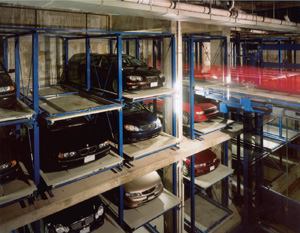
Acton’s system includes three levels: pit, ground, and upper. Each resident is assigned a specific parking space and issued an electronic key, which inserts into a computer panel. The machine moves cars vertically, while cars on the middle level rotate laterally. Monthly parking rates are $100 for both residents and the public.
The benefit of Camden Grand Parc’s fully automatic parking system is that “[residents] don’t have to worry about someone else driving their car. You’re the only one that can drive it,” Klein says. Additionally, the cars are parked underground and protected from harsh weather. Monthly parking rates are $210 for residents and $250 for nonresidents. SpaceSaver Parking Co., a Chicago-based division of Mid-American Elevator Co., installed the property’s 74-car automated system.
BREAKING THE MOLD Automated lifts aren’t the only innovative parking approach being employed by multifamily housing operators. In Santa Monica, Calif., residents at Sea Castle Apartments have the convenience of valet service. After the valet takes the car, it is parked on one of the lower lifts—the location depends upon the car’s size. Residents who leave their car with the valet upon arrival need only wait a few minutes at the parking entrance for the valet to retrieve the car. The cost for using this 24-hour service is included in the apartment rent.
With 178 units and only 71 spaces, parking had been a problem for Sea Castle since not long after its opening in 1926, says general manager Karen Mims. “There’s not one parking space per resident or one parking space per apartment, so the way we solved the problem was to offer complimentary parking,” she explains.
Saving space is the primary benefit of Sea Castle’s valet service. Using this system doubles the number of cars able to fit in the garage.
In New York City, AutoMotion installed the innovative parking system at SoHo South, a 24-unit apartment community on Baxter and Hester streets. At that property, a rotating turntable transfers cars to the storage and retrieval units. The turntable allows the driver to enter and exit in driving direction. The cars are positioned and parked on steel structures. Once identified by the system, the car travels upward on a metal platform. Known as the UP System, this structure can house cars of various sizes. Retrieval time is two minutes.
Along with convenience, the system offers several other green benefits. “The cars are not running, and the sterile environment eliminates harmful emissions. And the resident is the only one who drives the car,” says Ari Milstein, executive director for AutoMotion.
THE CRÈME DE LA CRÈME Some developers are working on even more creative ways to fit cars into tight spaces. Jim Donnelly, a developer with Pursuit Group of Charlotte, N.C., plans to construct a high-end garage for residents of the 20-story Encore Charlotte. This parking system would allow condo residents to drive into the first floor of their building directly into a car elevator. The resident would drive out of the elevator into a personal garage that is part of the condo unit, similar to a single-family home layout.
Donnelly emphasizes that because of the high price point, this type of high-rise parking system is uncommon for the typical multifamily property. “You can’t have a 500-unit high-rise because there are only a certain number of cars that each elevator can move,” he says.
Pursuit Group plans to break ground on the project in May and anticipates completion by December 2009. The cost for using this high-end parking system will be included in the condo fees.