
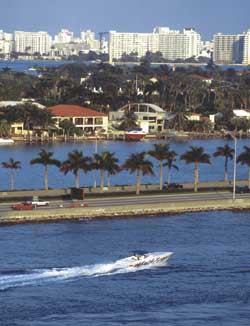
Beach Appeal
Employment growth continues to drive demand for multifamily housing in South Florida. Fort Lauderdale is expected to gain 32,000 positions in 2006, a 4.2 percent increase. Gains will be led by the construction and professional and business services sectors.
In West Palm Beach, forecasts call for 3.8 percent employment growth, with strong gains in the educational and health services sector, which will boost demand for apartments. Miami‘s employment is forecast to grow 2 percent, or 21,000 positions.
Several South Florida markets are attracting capital from both local and out-of-state investors. A large share of multifamily construction is in Palm Beach County, due to the availability of land and the area’s prospects for growth. The West Palm Beach metro has become a hub for cutting-edge bioscience and medical technology industries, which will attract well educated, higher-paid workers. Asset prices reflect this investor demand: Sales prices in West Palm Beach were up by more than 20 percent in 2005.
Hollywood, in Broward County, also has attracted investor interest. This market boasts strong rental demand and population in an area that is forecast to increase by 20,000 residents during the next five years. Investors like the relative affordability of this market: The median price per unit is roughly 20 percent lower than the rest of the Fort Lauderdale region.
The Flagler Village area in Fort Lauderdale, which has endured decades of crime and blight, is part of the city’s downtown master plan to redevelop the area into a vibrant live/work district. Developers are scrambling to acquire land and obtain approvals for their projects. Meanwhile, the city is motivated to allocate housing units to the area.
Recent sales in Fort Lauderdale included 1.25 acres on Broward Boulevard for $10.53 million to Groupe Pacific, which plans to build a 48-story high-rise mixed-use project, and a three-story office building at 33 N.E. Second St. to Claridge Homes, a large Canadian developer, for $5.25 million. Claridge plans to construct a 40-story condo tower on the one-acre site.
Developers and investors alike are scrambling to capture land in downtown Fort Lauderdale, especially within the parts of the area where there are no height or density restrictions. Previously, land sold in the range of $40 per square foot to $60 per square foot. That standard now has been pushed well beyond $150 per square foot.
Occupancies Improve
Robust demand and reduced development activity were expected to yield an 80-basis-point decline in Fort Lauderdale’s vacancy rate, down to 4.5 percent by the end of 2005, and a 160-basis-point decrease to 5.8 percent in West Palm Beach. Ten of 12 Fort Lauderdale’s submarkets boast vacancy rates below 5 percent. The star? The submarket of Davies, which has a vacancy rate of 3.3 percent, where it is expected to remain going into 2006. A recent measure to preserve the community’s open land should limit new apartment supply in the years ahead.
With reductions in vacancy expected to persist, asking rents were forecast to climb 2.8 percent in Fort Lauderdale to $1,003 per month by the end of 2005 and 2.7 percent in West Palm Beach to $1,035 per month. Effective rents also were projected to increase in late 2005, hitting $950 monthly in Fort Lauderdale and $970 in Palm Beach County.
Not to be outdone, Miami’s vacancy rate was expected to fall to 4 percent by the end of 2005, a significant drop from 2004’s 5.2 percent vacancy rate. Why? Population increases, job growth, and the removal of 2,600 apartment units from the market. Strong fundamentals were expected to help owners raise monthly asking rents region-wide by 2.5 percent by year-end 2005 to $1,020, with effective rents of $970.