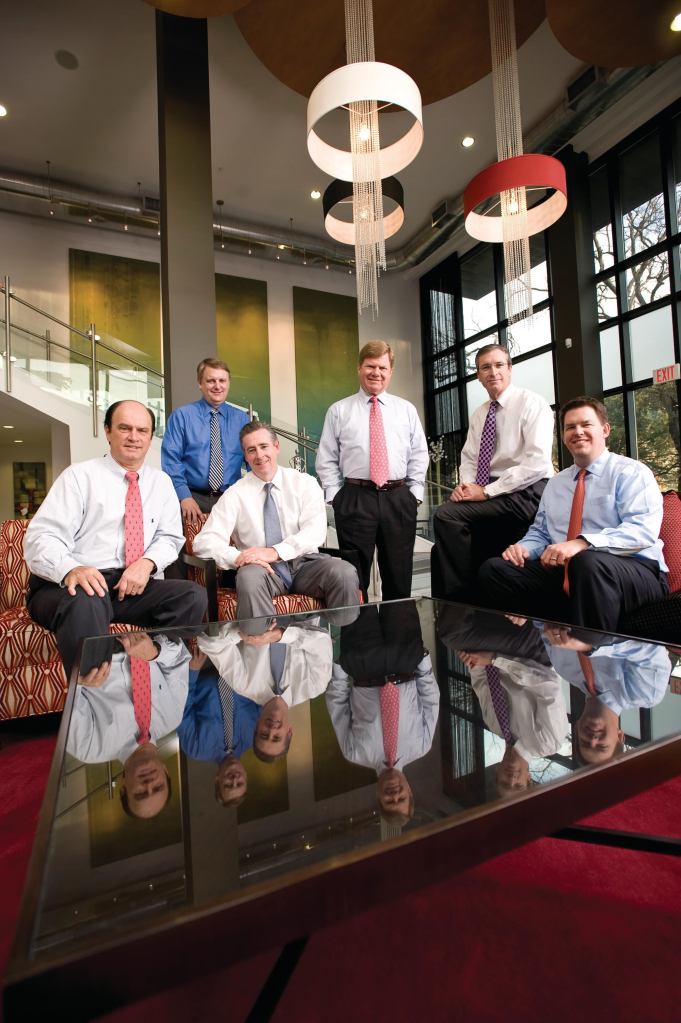
Regardless of what challenges may come, Sharon Dworkin Bell, the NAHB’s senior staff vice president of multifamily, has no reservations that the rest of the industry will be watching Brindell as he aims to transform TCR. He’s not Ron Terwilliger, but he is the new chief of Trammell Crow Residential. And that demands attention.
“Because they are such a leader in the industry, they’re a role model for everyone else,” Dworkin Bell says. “A lot of people will be looking at the kinds of decisions he makes to see what types of solutions and approaches he comes up with.”
Pruning Markets
With its core markets, Trammell Crow Residential has decided that eight is enough.
Under its new reorganization, Trammell Crow Residential (TCR) will focus on eight core markets, each of which will serve as business divisions. That doesn’t mean it won’t have properties (and hold them for extended periods of time) in non-core markets, but smaller areas will simply serve as satellites for the larger markets.
The eight core markets are: Northern New Jersey and New England (Long Island and Boston were formerly separate); the Washington, D.C., metro area (Raleigh-Durham and Charlotte will be rolled into this office); Atlanta; South Florida; Houston (which will include Austin and San Antonio); Dallas-Fort Worth (which will include Denver); Southern California (which includes Phoenix); and Seattle and Portland (Northern California will be folded into this office). Although North Florida and Phoenix aren’t considered core markets, the firm will retain offices in both areas.
“We want to concentrate capital and human resources in markets where we’ve been most consistently profitable and where we believe there is opportunity to continue creating value and generating profits going forward,” says Charlie Brindell, TCR’s president and CEO.
When choosing the markets, TCR went with a mix of high-barrier markets, along with markets such as Atlanta, which can sustain large growth number when times are good. “They are institutional-quality markets,” says Mark Dempsey, TCR’s CFO and head of acquisitions. “Buyers always want to be there.”
They’re also markets where the company has established roots and relationships. “If you try to build an organization as opportunities are emerging, you will inevitably stumble,” Brindell says. “You are going to spend a lot of money and pay a big ‘dumb tax’ if you don’t have people who know and understand these markets.”
Déjà Vu
During the last real estate down cycle, property management was a lifeline for Trammell Crow Residential. With the current economy, will the firm consider management again?
IN THE ’90S, it wasn’t development that carried the day at Trammell Crow Residential (TCR).
“Property management was very profi table for us then,” says Ron Terwilliger, former chairman and CEO of the company. “It helped get us through without too much pain. We dramatically downsized our construction and development operations during that cycle. The Crow family had some problems, and we didn’t have any capital from them. But we could survive in part because property management was profitable.”
But as time wore on, more firms (including merchant builders) entered property management and margins grew thinner. The company was generating much greater returns building and selling apartments. In fact, property management was becoming a distraction, complicated by the organization’s decentralization. So five years ago, TCR sold what later became Dallas-based Riverstone Residential , which has since grown to be the second-largest third-party property manager in the industry.
“When we created Riverstone, we had seven or eight different managers out there, and they were all running it differently,” says Christy Freeland , Riverstone’s chairperson. “We had to figure out a way to make everyone more consistent.”
With that memory still fresh, TCR executives aren’t eager to jump back into property management as they reorganize their asset management group. “We currently understand the advantage of using third-party management companies and the advantage of having our own management,” says Ken Valach, TCR’s head of asset management. “We probably understand that as well as anybody in the industry.”
But Valach and other executives admit that the subject of property management has come up on a number of occasions. “I suggested eight to 10 months ago to rethink whether that was the business to be in,” Terwilliger adds.
Some think TCR would be in better shape financially today had it kept its property management business, but Valach says the firm isn’t pinning itself into a corner. And there are no plans today to move into that sphere.
“The most overriding reason we would do it [get into management] is if capital demanded it,” Valach says. “Using the REITs as an example, in the early ’90s, there were REITs that used third-party managers. As other REITs came out and argued that property management was an integral function of the company, Wall Street pushed REITs to do management in-house.”
Time to Buy
The longtime developer unveils a new emphasis on acquisitions.
AFTER YEARS OF focusing largely on development, Trammell Crow Residential (TCR) is now focused on acquisitions. And TCR’s CFO and head of investment/acquisitions Mark Dempsey says the company won’t be deterred by physical distress.
“We’ve talked to a number of lenders about helping them on a consulting basis or potentially looking to purchase that stuff if they get it,” he says. “We’re not limited to complete properties that don’t need some cosmetic upgrade or to finish construction.”
Still, TCR will primarily be looking at Class A deals with a five- to seven-year hold time. Dempsey expects to look for deals in the $90,000 to $140,000 a unit range in the central markets and $200,000 to $300,000 units in the coastal markets. TCR’s president and CEO Charlie Brindell would like anything the firm incorporates into its portfolio to fit into its existing Alexan brand. In the past, the company hasn’t been able to really grow this brand because TCR sold the majority of its assets. But now, as it’s holding properties for longer investment periods, there’s an opportunity.
“One thing we’ll spend time on going forward is thinking about the Alexan brand as part of our asset management effort and the possibility for leveraging that brand in better ways than we have today,” Brindell says. “I think we have a good brand, but I don’t think it’s as widely understood or appreciated on the consumer side as it could be.”
ALL IN THE FAMILY
Iconic developer Trammell Crow and his family of companies produced some of the industry’s most influential executives. Check out who got their start with the developer.