
What’s WiMAX?
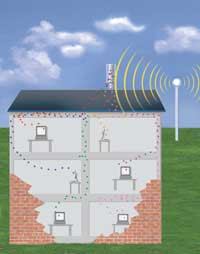
Like Wi-Fi, WiMAX is a technology standard that enables wireless Internet access but at much greater distances and speeds. Whereas Wi-Fi was designed to be effective only within several hundred feet of an antenna, WiMAX can travel for tens of miles, at speeds that can be several times greater than the average DSL line. Unlike with Wi-Fi, though, laptop computers aren’t set up to receive its signal yet and might not be for several years. In other words, for now, you’ll still have to set up a network inside your building to get the signal to residents’ computers.
But WiMAX is likely to provide an alternative, cost-effective “fat pipe” to get a high-speed connection to multifamily properties in need. “In our trial, the pre-WiMAX was used as nothing more than the replacement for a big T-1 connection to the Internet,” says John Sternberg, vice president of community technologies at BellSouth. “We still used Wi-Fi to extend that signal out into all of the apartments, without any wiring.” Pointing to just such examples, many observers predict that instead of supplanting Wi-Fi, WiMAX will happily coexist with the technology.
“WiMAX is a last-mile technology,” says Jeff Thompson, CEO of TowerStream, a Middletown, R.I.-based wireless broadband provider that has “lit up” approximately 750 office buildings and a handful of apartment communities nationally. “Wi-Fi works for the last several feet. They are going to work together.” Thompson expects WiMAX to make broader inroads in the United States this year, with increased demand for the technology in 2007.
Another speed bump in the rollout of WiMAX comes in the form of equipment certification. While broadband wireless technologies have existed for several years, they haven’t been standardized under one technological umbrella so that all equipment is guaranteed to work together. (Imagine needing a different Wi-Fi card in your laptop for every coffee shop you visit.) The WiMAX Forum, an industry standards group, is beginning the process but only started putting its stamp of approval on equipment earlier this year. Observers say widespread manufacturing and availability of such equipment are still years off. That’s why BellSouth’s trial run, so far, has still been using pre-WiMAX equipment.
“Basically, WiMAX isn’t really WiMAX yet,” says Rick Schiffmann, CEO of Warwick, R.I.-based ICOA Corp., which deploys broadband wireless networks at airports, restaurants, and hotels. “But that problem is going to be solved.”
Case in point: The WiMAX Forum has already certified 14 individual devices this year, and communications heavyweights such as Sprint Nextel, AT&T, and BT (formerly British Telecom) are on the organization’s board. In fact, WiMAX’s highest-profile supporter is none other than chipmaker Intel, which has said it will start producing WiMAX-enabled chips for use in laptops by 2007, albeit past projections have repeatedly been pushed back.
Regardless, the bottom line is that WiMAX is coming, even if its exact arrival date is still uncertain. One thing’s for sure: It will provide multifamily operators with a new alternative for high-speed Internet connectivity, and it could do so for fewer dollars per door.
“There is going to be a right way and a wrong way to use WiMAX. Using it in an apartment setting seems like a natural fit,” says Derek Kerton, head of the Kerton Group, a San Jose, Calif.-based consultant specializing in wireless technology. Kerton says companies are likely to offer WiMAX connectivity at 80 percent of the cost of a typical T-1 line, while providing faster speeds of connectivity.