
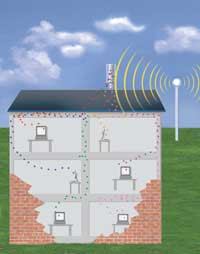
In areas underserved by pre-laid cable or fiber wires, beaming a signal to the top of a building could be a hugely cost-effective alternative to digging trenches. Savvy operators might be able to rent out their roofs for tower space or partner with operators to provide the service to clients. TowerStream, for instance, says it bills a flat rate of $5,000 per month to a residential building in Manhattan, which then sells the service, at a profit, to its residents. (A third party takes care of maintenance and customer support.)
Also, because wireless broadband is still possible in the unlicensed portion of the radio spectrum, independents can offer the service directly to residents, providing a cost-effective alternative to negotiating with the local cable or telephone company.
That was the case at Jackson Chang Apartments, a local operator of student apartments in Denton, Texas, home to the University of North Texas. “College kids need two things: TV and the Internet,” says Gary Chang, a partner at the firm. “But when we went in to negotiate with the cable company for service, they wanted a lot of concessions that didn’t make sense for us.”
The solution came from Richardson, Texas-based Airimba Wireless, a wireless broadband provider focused on the multifamily market. The firm agreed to install pre-WiMAX antennas on each of Chang’s buildings, asking only that Jackson Chang pick up the cost of powering the receivers, which Chang characterizes as “nominal.”
Then, by putting Wi-Fi access points in the attics between floors, the firm distributed the signal to students’ laptops. Individual passwords that can be used by only one person at a time allow students to log on. “All the residents needed to do was pay [Airimba Wireless] a flat fee of 25 bucks a month and that was the end of it,” Chang says. Best of all? Jackson Chang didn’t have to enter into an exclusivity agreement and limit its tenants’ choices.
“They’re not required to take it. It’s just another option for them, and it’s cheaper than the bundled alternatives that they have,” Chang says. “Anytime we can reduce their living expenses, we can increase rent and revenues while reducing turnover. We don’t have to deal with any technical aspects. We just concentrate on providing the best living environment possible.”
Joe Bousquin is a freelance writer in Newcastle, Calif.
How to Work WiMax Into Your Tech Plans
1 Use WiMAX as a “fat pipe” alternative to get high-speed access to your building. Getting the signal directly to individual users’ laptops is still years away.
2 Networks will still be needed inside your building, through either wires or Wi-Fi access points.
3 WiMAX isn’t magic; it faces the same physical limitations posed by concrete and steel walls for Wi-Fi. As with cell phone technology, there may be dead spots in “problem properties.”