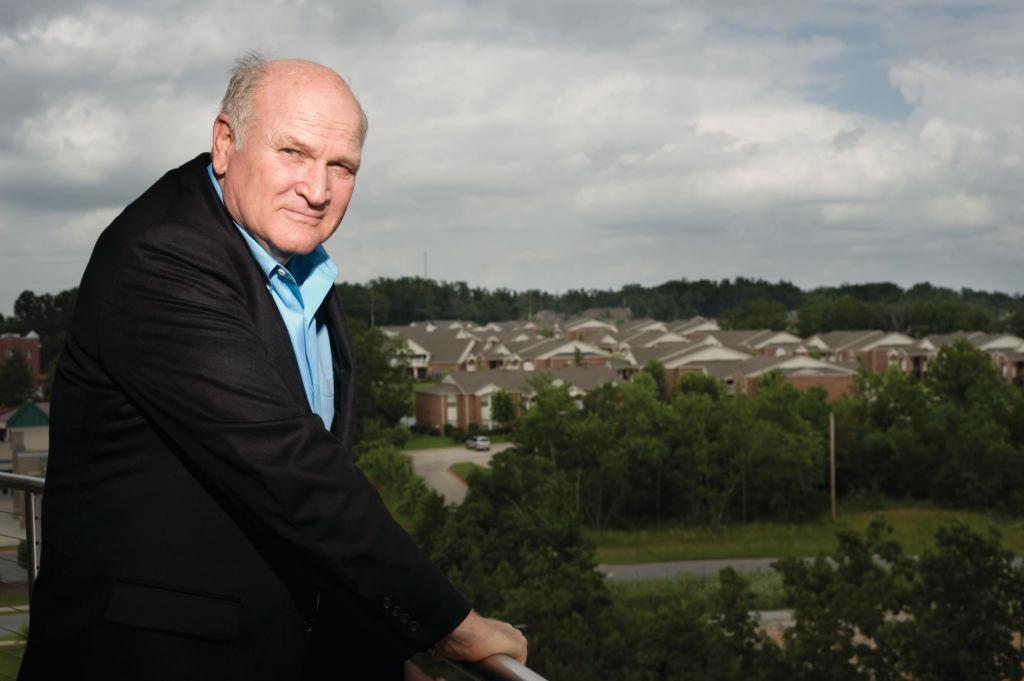
At 21, Lindsey bought a plot of land in Fayetteville across from what became the mall. Three years later, he sold it for a “multiple” of what he paid for the land. After Lindsey finished playing football in 1972, he turned his full focus to real estate, dealing primarily in commercial assets.
In the ’80s, he converted some of that success in other sectors to multifamily, building small apartment complexes in nearby Rogers and Springdale, Ark. The company started branching out—entering Oklahoma, Arkansas, Alabama, Kansas, Mississippi, Missouri, Nebraska, and Tennessee. Even then, the firm stayed focused on smaller, tertiary markets and college towns.
“He doesn’t have any intention to go into downtown Dallas or Atlanta or Chicago and try to compete,” says Brian Carlton, director at Dallas-based HFF, one of Lindsey’s permanent lenders. “That’s not his deal. For the markets he’s building in, you have renters who have never lived in a Class A, four-story wrap with structured parking.”
These may not be the coastal, high-barrier-to-entry markets that the institutions seek out. But for Lindsey, they work well. By having a regional focus, Lindsey can use real-time, on-the-ground information to know whether a market can absorb more supply (though he admits that high occupancy levels have occasionally lured him to overbuild in some of these markets).
Take for instance the 312-unit property it’s looking to build in Pearl, Miss., a town of more than 20,000 people. “We did a deal in Madison, Miss., which is not far from Pearl, and it’s been a tremendous success for us,” Lindsey says. “The economics of Pearl look similar to Madison.” Who would have known that? A math major who still employs his skills on a daily basis. “He is a mathematician by degree, so everything is a math equation to him,” says Jim Taylor, president of the Northwest Arkansas division of Fayetteville-based First Security Bank. “He does math equations faster in his mind than most people can do them with calculators. You can be sitting there in a conversation with him, going over different scenarios, and before you start to crunch the numbers and work through some of those different scenarios, he already has it worked out in his mind and is telling you the answer.”
And Lindsey possesses additional insights and pieces of local intelligence. For instance, in many ways, Lindsey’s growth mirrored that of fellow Fayetteville corporate resident Wal-Mart. (Lindsey is actually in The Sam M. Walton College of Business at the University of Arkansas, along with former college teammate and Dallas Cowboys owner Jerry Jones.)
“What’s helped is he’s been down there and has all of those ties,” says Robert Ryan, a managing director at New York-based M&T Realty Capital Corp., which is one of Lindsey’s permanent lenders. “He’s been very close to the Walton family. It’s funny how some of his properties are across the street.”
2) Know What’s Going on Inside Your Company. And Make Sure Your People Know, Too.
Walk inside Lindsey’s office and you’ll see the usual decor—pictures, stacks of paper, and a couch, but one very important thing is missing. There’s no desk. Lindsey says the couch is more comfortable and informal. But don’t take that as a sign that Lindsey is asleep at the wheel. In fact, nothing could be further from the truth.