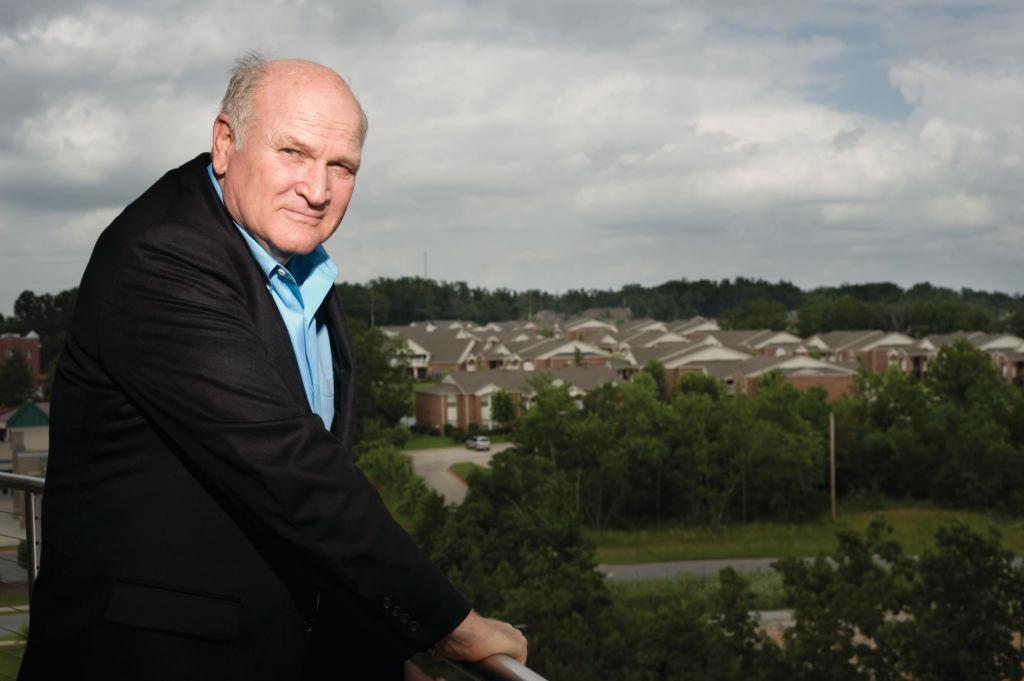
“There are papers everywhere, and he knows what’s on every one of those pieces of paper,” says Harvey Williams, president of the Northwest Arkansas division for Bank of the Ozarks, which is one of Lindsey’s longtime construction lenders. “When you ask him a question, he doesn’t have to call someone and ask what the number is. He already knows it.”
Leadership Lessons: Jim Lindsey

Title: CEO
Age: 65
First Professional Job: Pro football player with the Minnesota Vikings
Best Business Decision: Coming home to Northwest Arkansas when my professional football career was over
Favorite Quote: “Do unto others as you would have others do unto you.”
Greatest Business Challenge: How to rent a vacant apartment
People You Most Admire: Winston Churchill, Margaret Thatcher, Ronald Reagan
Best Advice Ever Received: Treat everyone with respect.
Last Book Read: The Life of George Washington by David Ramsay (1807)
Each morning, Lindsey gets a company-wide report that was conceived and developed by chief financial officer and president of corporate operations Scott Roggerson. It’s massive: three-quarter-of-an-inch thick, printed on legal-sized paper in size 8 font. The report provides property and portfolio data, including vacancies, the number of units under deposit, uncollected rents, and incomplete maintenance requests. “He’ll call managers if it doesn’t look good,” Roggerson says. “He knows that report better than anybody in this office.”
And he knows his property managers. And their spouses. Back in the late ’80s, Lindsey decided that his managers needed to live on-site to be most responsive to resident concerns. So, he set them up in 1,600- to 2,200-square-foot suites above his clubhouses. That way, if there’s an emergency at 3 a.m., they’re available. “He has really good managers, and he pays them well for the value that they’re giving to him,” Williams says. “His managers are incentivized to keep vacancies low. If they’re able to do that, then they’re rewarded.”
While the managers are tasked with dealing with on-site issues, regardless of the hour, key decisions, such as rents and purchasing, are made at the company’s Fayetteville headquarters. Those decision-makers have rich experience, though. Lindsey says that most of his core leadership team has been with him for at least 15 years. Unlike the culture at some other companies, these executives don’t leave after five years to compete with Lindsey.
“His executive management team can still answer our questions and are on top of their area of responsibility,” Williams says. “For us, as bankers, that gives us a lot of comfort because they know what they’re doing and what situation they’re in. They can give you that information when you need it.”
3) Develop and Stick to a Construction Template.
When you visit a Lindsey building, don’t expect to see him building gleaming, glass high-rises against urban skylines. That’s not what he does. But he does build bricked “stacked and backed” apartments with assembly-line consistency. And in this economy, that’s the kind of certainty that lenders are looking for.
Lindsey doesn’t really have a goal as to how many units he’d like to own, but he feels comfortable adding between 1,400 and 2,400 units per year. The firm has been building that much since 1995, and since then, the product hasn’t varied much.
The typical Lindsey product features a row of six units on either side of a chase (double studded) wall and insulation. The units are backed against each other with plumbing and electrical snaking down the middle of the structure, making them energy-efficient for the residents and the company in its construction process. “It’s been done many times,” Roggerson says. “If they don’t have the backed and stacked effect, I think you’re talking about a 20 percent difference in costs.”