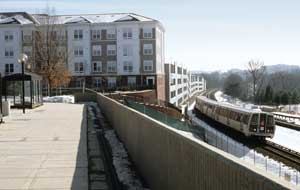
After getting through the necessary steps, the developer often is required by the agency to abide by its contracting code, which includes using union workers. This can add as much as 20 percent to a firm’s costs in construction.
But these requirements do not mean governments aren’t open to innovative suggestions when they want communities to be built. For example, often the government will kick in the costs for parking or some other aspect of the development.
This happened to Michael Dieden, a principal with Creative Housing Associates, a Los Angeles-based firm focused on developing infill housing in California. His company partnered with Los Angeles’ Metropolitan Transit Authority (MTA), the city of Pasadena, and the state of California to build on MTA’s Gold transit line. Five million dollars of public money enabled the company to build public parking and underground utilities around the station site. The company also built 53 condominiums and 14 lofts.
When the land near a transit site is privately owned, one option is to do a joint venture with the owner. Wood partnered with a family that owned land near the 10th Street Metropolitan Atlanta Rapid Transit Authority station in midtown Atlanta.
“Buying sites is getting more expensive and complicated,” Wood says. “[Partnering with a landowner] is an outstanding way to do it, but it’s not for everyone because a lot of landowners just want to get their cash” instead of going into a joint venture.