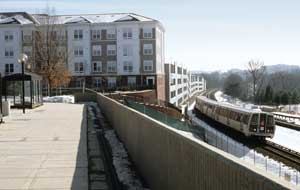
Jumping Through Hoops Getting land is only half the battle. Many communities have detailed visions of how they want their rail stops to look. It’s the developer’s job to make it happen. “The development agency [or planning board] works with the transit authority on their comprehensive [development] plan,” Neely says. Based on the consultation, the transit authority will have requests for retail services and a certain amount of housing. It also will want parking to increase ridership.
The need for parking becomes even more pronounced at some of the last transit stops on a line, where commuters will be driving in from distant suburbs and rural areas to get into a city. Parking costs can add $65 to $85 per square foot, according to Griggs. “You can only do it in areas where rents can substantiate the economics of doing replacement parking,” he says. “In some of the outlying areas, it would be difficult if you can’t get the rents to substantiate the cost of the parking.”
A top priority for cities and counties is affordable housing. When BRE builds near transit, localities require it to build affordable housing, Griggs says. And, Dieden says, in some of his projects, cities will ask for as much as 20 percent of the units in a development to be affordable.
When this happens, there is usually an underwriting gap of approximately 20 percent between what the project will be budgeted at and what the developer needs to make it a reality, according to Dieden. “Affordable housing has to be absorbed by the public,” he says. “There is a gap, and public financing has to close the gap.”
The Retail Component
During the past five years, village-type environments have sprung up around many transit stops, featuring multifamily housing, shops, offices, and even gyms and movie theaters. The retail element aims to create a “see and be seen environment,” says Tom Low, a director of town planning for the Charlotte, N.C., office of the architectural firm of Duany Plater-Zyberk & Co.
Unfortunately, most multifamily builders just aren’t familiar with building retail. “Retail is a four-letter word for us,” Griggs says. “We specialize in building high-density apartments.”