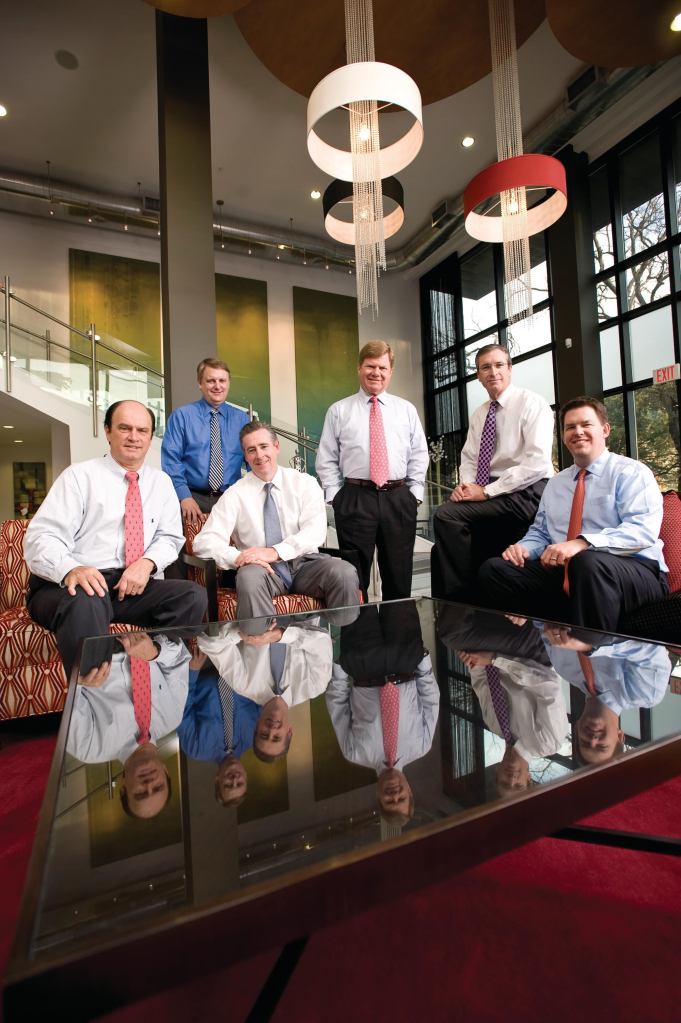
“Charlie has been more focused on the investment side and return side of the business,” says Ron Witten, CEO of Witten Advisors, a Dallas-based real estate advisory firm that provides forecasts for TCR and has written the firm’s annual Apartment Market Outlook report every year since the early 1990s.
“If that’s from development, great. But if it’s from another investment, that’s fine, too. Ron understood returns, but in the vast majority of his career, he’s been an apartment developer,” Witten adds.
Brindell stepped into the role of a director of Trammell Crow Residential in 1998 and came aboard as COO in June 2008. His shift into the CEO role a few months later has not been without its challenges, though. For one, Brindell plans to instill this idea that the best investment of capital and human resources wins in an organization that has “been at the apex of the merchant builder group,” according to Mark Humphreys, CEO of Dallas-based Humphreys & Partners Architects, which has worked with TCR on designing several projects in cities including Chicago and Dallas. And that best investment no longer has to be (or can be, in today’s economy) development.
“In the future, I don’t want our partner in ‘Atlanta’ to feel like the only way to create value is to develop a new apartment community,” Brindell says. “If the market is telling us we should be buyers rather than builders, then we ought to be buying.”
To make this happen, Brindell is once again turning to his team. Leading the national acquisitions and investment effort is Mark Dempsey, who is also TCR’s CFO. Meanwhile, executive managing directors MacDonald in the East and Mike Collins in the West will be responsible for development, construction, and acquisitions in their regions and report directly to Brindell.
“We want to use our local resources and talent to help identify and evaluate acquisitions and other investment opportunities,” Brindell says.
So does this renewed focus on acquisitions mean that the country’s preeminent apartment builder has abandoned the shovel altogether? Not quite, Brindell says. It just won’t be as great of a focus for the new TCR. In fact, TCR wants to break ground on six new developments (five in the Northeastern corridor and one in Southern California), totaling about 2,000 units, in 2010 (it has one start slated for the first quarter). “We’re in position to carry enough of our development and construction capacity though this for the next 24 to 36 months,” Valach says. “We had enough retained earnings that we’re in a position that we can do that.”
3) Push efficiencies.
Call it entrepreneurial flair. Call it decentralization. Whatever you call it, the TCR of the past gave its partners latitude.
Terwilliger wanted results, so in lieu of reports and investment committees, he would rely on intuition. “There was a functioning board, but Ron pretty much ran the show as a benevolent admiral,” says Michael Melaugh, TCR’s executive managing director in charge of capital markets, who, like Terwilliger, served in the Navy. “At the end of the day, Ron was determining where the offices would be located, how much business we would do, and what type of business it was. Once the plans were determined and the level of development was decided, he was not a micro-manager.”
Ultimately, that structure gave partners out in the field a lot of leeway. “The advantage that we had as I ran the organization was that you could attract strong partners, and they had the opportunity to run their own businesses,” Terwilliger says. “I was pretty much the investment committee.”
Partners were responsible for finding the deals and lining up the equity and debt. “In the past, we might have had partners in Dallas, Atlanta, Los Angeles, and Washington, D.C., all of whom wanted to start a new development within three months of one another, and they all pursued capital independently,” Brindell says. “They could have been talking to the same bank and the same group of equity partners.”